Pour Over vs Cold Brew: Which Coffee Maker Should You Buy?
As an Amazon Associate, Cozylis earns from qualifying purchases. Prices change often — please check the current price on Amazon before you buy.
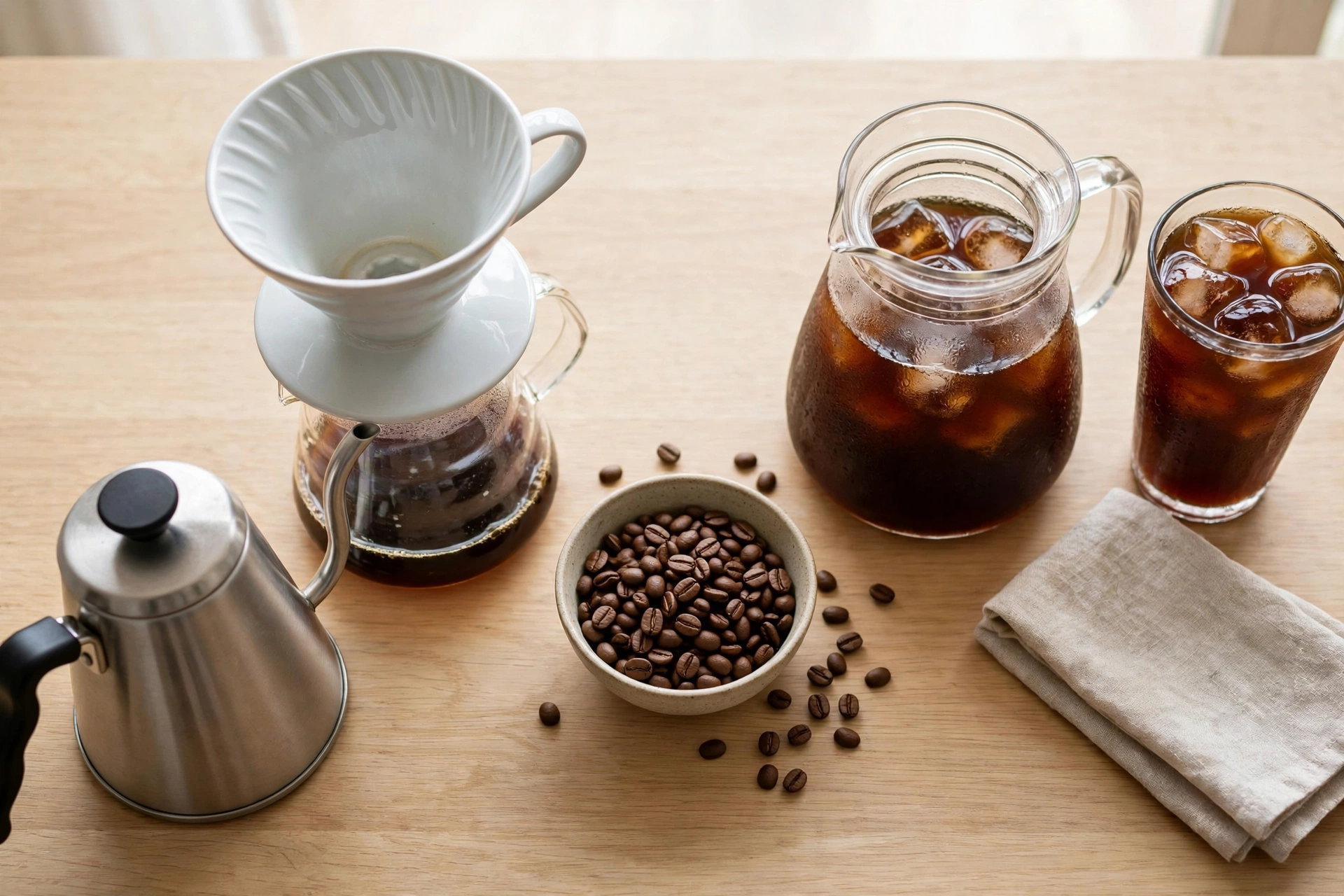
Two mornings in my kitchen, same beans, two completely different cups. On Saturday I stand at the counter with a gooseneck kettle, pouring hot water in slow circles over a V60, and the kitchen smells like a café. On a July weekday I open the fridge, pour cold brew over ice, and I am drinking coffee thirty seconds after waking up. Both are good. They are just good at different things.
If you are choosing between a pour over and a cold brew maker, the question is not which one is better. It is which morning you actually live. This guide compares them the way I wish someone had compared them for me: taste first, then time, cost, effort, and the honest downsides of each.
Jump to section (12)
- The short answer
- Taste: bright and clear vs smooth and sweet
- Time and effort: five minutes now vs five minutes last night
- Cost: what you actually spend
- Who should buy a pour over?
- Who should buy a cold brew maker?
- Can you have both? Yes — and it is cheaper than you think
- Two extras from the full guides
- What the other guides skip
- Mistakes to avoid when choosing
- Care in one paragraph
- Frequently asked questions
The short answer
| Pour over | Cold brew | |
|---|---|---|
| Taste | Bright, clear, hot — you taste the bean | Smooth, sweet, cold — mellow and low-bite |
| Time to first cup | About 5 minutes | 12–24 hours (plan the night before) |
| Effort | Standing, pouring, paying attention | 5 minutes of prep, then the fridge does the work |
| Best for | Slow mornings, light roasts, one or two mugs | Iced lattes, summer, batch brewing for the week |
| Starter cost | $10–$55 manual; ~$190 automatic | $20–$50 pitcher; ~$150 for a rapid brewer |
| Served | Hot, straight away | Cold, over ice, or diluted from concentrate |
If you love hot coffee and the ritual of making it, buy a pour over. If you live on iced coffee in warm weather, buy a cold brew pitcher. If you genuinely do both — hot in winter, iced in summer — get both. Together they cost less than one automatic machine, and you will use both.
Taste: bright and clear vs smooth and sweet
This is the real difference, and it comes down to heat. Hot water extracts flavour fast — acids, aromatics, oils, all of it, in about three minutes. That is why a pour over tastes bright and detailed: a light roast from Ethiopia tastes floral and fruity through a V60 in a way no other method shows. The cup is clear, layered, and alive. It is also less forgiving. A bad pour over tastes sour or bitter in ways you cannot hide.
Cold water extracts slowly — 12 to 24 hours — and it leaves many of the sharp, acidic compounds behind. The result is smooth, sweet, and mellow, with a heavier body and almost no bite. Chocolate and caramel notes come forward; bright fruit notes step back. Cold brew rarely tastes bad, which is part of its charm. It also rarely tastes extraordinary. A spectacular single-origin bean will show more of itself in a pour over than in a cold brew pitcher.
My honest take: if you buy good beans and want to taste what you paid for, pour over wins. If you want a reliably smooth, sweet cup every time with zero skill, cold brew wins. They are two different drinks from the same bean.
One more thing people get wrong: iced pour over is not cold brew. Pouring hot pour-over coffee over ice gives you a bright, iced cup in five minutes — and it is lovely — but it is not cold brew. It has the acidity and clarity of hot coffee, just cold. If you want that smooth, low-bite cold brew taste, only time and cold water give it to you.
Time and effort: five minutes now vs five minutes last night
Pour over asks for five minutes of your attention, right now. Grind, bloom, pour in slow circles, wait. You are standing at the counter. On a slow morning that is the point — it is a small ritual that makes the day feel unhurried. On a rushed Tuesday it is the reason the brewer sits unused and you reach for the instant coffee.
Cold brew asks for five minutes last night. Coarse grounds, cold water, into the fridge. Then nothing. In the morning you pour and drink. The effort is planning, not doing. The failure mode is not technique — it is forgetting. Forget to start a batch on Sunday night and there is no cold brew on Monday, and no way to fix that in five minutes. (Unless you own the Dash Rapid, which makes cold brew in about 5–15 minutes — at around $150.)
Here is the question that decides it: are you a morning person who enjoys a ritual, or a planner who likes things ready? Be honest. I am a ritual person on weekends and a planner on weekdays, which is exactly why I own both.
Cost: what you actually spend
Pour over
- Manual: a plastic Hario V60 02 costs about $10–$15, a Kalita Wave 185 about $30–$40, a Chemex 6-Cup about $45–$55, a Clever Dripper about $35. That is the whole brewer.
- Automatic: a Bonavita Connoisseur 8-Cup is around $190, an OXO Brew 8-Cup around $196. You pay for temperature control and the push of a button.
- Running costs: paper filters. V60 filters are cheap and everywhere. Chemex filters are thick, bonded, and the most expensive here. Kalita Wave filters cost more per cup than standard cones. A scale and a gooseneck kettle help a lot with a V60 and cost more than the brewer itself if you buy both — budget for them, or start with the forgiving Kalita or Clever Dripper, which do not need a gooseneck.
- What lasts: a manual dripper is nearly indestructible. A $15 V60 can last years. An automatic machine needs descaling and will eventually need repair or replacement.
Cold brew
- Pitchers: a Primula Burke is around $20, a Takeya 1-Qt around $25, a Hario Mizudashi around $25, an OXO Good Grips around $50.
- Rapid brewer: a Dash Rapid is around $150.
- Running costs: almost nothing. The mesh filters are reusable — rinse and go. Toddy-style felt and paper systems are the exception, with ongoing filter costs.
- What lasts: a Tritan pitcher like the Takeya is shatterproof and dishwasher safe. Glass pitchers look better and break more easily.
The honest maths
The cheapest way into each is nearly the same: about $15 for a V60, about $20 for a Primula. The cheapest way into both is about $35–$40 total — a V60 plus a Takeya or Primula — which is less than a single automatic pour-over machine. If budget is the deciding factor, that is the answer: buy both manual options, skip the machines, and spend the saved money on better beans and a burr grinder. The grinder improves both methods more than any brewer upgrade will.
Prices are ranges reported in independent review roundups in November 2026. They are not verified on Amazon — please check the current price on Amazon before you buy.
Who should buy a pour over?
You, if: you drink your coffee hot, you enjoy a slow morning, you like light or medium roasts and want to taste them properly, you make one or two mugs, or you like the idea of coffee as a small daily ritual rather than a caffeine delivery system.
The best first pour over: the Kalita Wave 185 if you want consistency without a learning curve, the Clever Dripper if you want it nearly foolproof, the Hario V60 02 if you love light roasts and do not mind practising. Read the full guide: Best Pour Over Coffee Maker — it covers six picks, exact recipes, and the mistakes I made learning.
Skip pour over if: you only drink iced coffee, you are out the door in ten minutes, or you know you will not stand at a counter pouring water in circles. Buy the cold brew pitcher instead and do not feel guilty. The best brewer is the one you use.
Who should buy a cold brew maker?
You, if: you drink iced coffee most days, you make iced lattes, you like smooth, sweet coffee with no bite, you are happy to plan the night before, or you want a week's worth of coffee from one Sunday-night batch.
The best first cold brew maker: the Takeya 1-Qt if you want the simplest start, the OXO Good Grips if you drink it daily and want concentrate, the Primula Burke if you are testing the habit for $20. Read the full guide: Best Cold Brew Coffee Maker — five picks, exact ratios, and how long each batch keeps.
Skip cold brew if: you only drink hot coffee, you never plan ahead, or you want to taste the bright, fruity notes of a light roast. Cold brew will flatten those notes. Pour over is your method.
Can you have both? Yes — and it is cheaper than you think
This is the option most comparisons skip, and it is the one I actually recommend for a lot of kitchens. You do not need two machines. You need two simple brewers that share everything else: the same beans, the same grinder, the same scale.
- Hot mornings: Hario V60 02, about $10–$15. Ratio 1:16, medium-fine grind, water at 93–96°C, bloom 45 seconds, slow pour, about 3 minutes.
- Iced afternoons: Takeya 1-Qt, about $25. Coarse grind, about 106 g coffee, cold water, 24 hours in the fridge, lift the filter, pour over ice.
- Total: about $35–$40 for both brewers. One bag of beans serves both. One grinder serves both.
The only thing you need twice is fridge space for the pitcher and counter space for the dripper. If your kitchen is small, the V60 and the Takeya are both compact — the Chemex and the OXO are the ones that demand shelf space. Start with the small pair, and upgrade only the method you end up using every day.
Two extras from the full guides
The Hario Switch, for pour over. If the V60 sounds like the cup you want but the technique sounds like a chore, the Switch is a V60 with a valve: close it and the coffee steeps like a French press, open it and it drains like a pour over. Same bright cup, far less punishment. It is the gentlest way into proper pour over, and it is covered in full in the pour over guide: Best Pour Over Coffee Maker.
The Toddy Home system, for cold brew. If you brew cold brew every week and you are tired of replacing whole makers, the Toddy is built around replaceable felt filters and paper bags, with a glass decanter underneath. More pieces and an ongoing filter cost, but the cleanest cup of any home system and nothing to throw away when a part wears out. Full details in the cold brew guide: Best Cold Brew Coffee Maker.
What the other guides skip
Most pour-over-versus-cold-brew comparisons stop at taste and time. Three things they leave out, and all three change the buying decision:
Buy the grinder before the machine. A $190 automatic pour-over machine with pre-ground supermarket coffee makes worse coffee than a $15 V60 with freshly ground beans. A burr grinder — a Kingrinder K6 hand grinder at around $100, or a Baratza Encore ESP or Fellow Opus at $150–$180, both ranges reported by DripRoast in November 2026 and UNVERIFIED on Amazon — improves both methods more than any brewer upgrade will. If your budget only stretches to one thing, make it the grinder, not the machine. The full grinder and kettle picks are in the pour over guide: Best Pour Over Coffee Maker.
Try cold brew in a French press before you buy a maker. If you already own a French press, you already own a cold brew maker: coarse grounds, cold water, 12–24 hours in the fridge, press slowly, pour. It is not as clean as a mesh pitcher, but it costs nothing and tells you whether you actually like cold brew before you spend $25–$50 on a dedicated maker. Cafe & Crema recommends this try-first step, and it is the cheapest honest test on this page. The full cold brew guide has the ratios: Best Cold Brew Coffee Maker.
The cheapest way into both is still $35–$40. A plastic V60 at $10–$15 plus a Takeya or Primula pitcher at $20–$25, one bag of beans, one grinder. That is less than a single automatic machine — and it is the answer most guides skip because there is nothing expensive to sell you in it.
Mistakes to avoid when choosing
Buying for the person you wish you were. The slow-morning ritual person buys a Chemex and uses it twice. The iced-coffee-every-day person buys a V60 and never learns the pour. Buy for the mornings you actually have.
Expecting cold brew from hot coffee over ice. It is a good drink, but it is not cold brew. If you want the smooth, low-bite taste, you need the overnight steep.
Judging cold brew by one bad batch. Most bad cold brew is a grind problem, not a maker problem. Too fine a grind makes it bitter and muddy in any pitcher. Go coarse — like raw sugar — and try again before you blame the brewer.
Buying the machine before the grinder. A $190 automatic pour-over machine with pre-ground supermarket coffee makes worse coffee than a $15 V60 with freshly ground beans. Spend on the grinder first. It improves every method you own.
Forgetting the filters. Chemex filters are expensive and proprietary. Kalita Wave filters cost more than standard cones. If ongoing cost bothers you, the V60 (cheap filters everywhere) or a mesh-filter cold brew pitcher (no filters at all) is the honest choice.
Care in one paragraph
Rinse manual brewers after every use and wash with warm soapy water. A Chemex needs a long bottle brush for the narrow neck. Rinse cold brew mesh filters after every batch — dried coffee oils go rancid fast. Keep cold brew sealed in the fridge and follow your maker's storage guidance. Descale automatic machines every two to three months. That is the whole maintenance list.
Frequently asked questions
Is cold brew stronger than pour over?
Usually, yes — especially concentrate, which is brewed around a 1:4 or 1:5 ratio and meant to be diluted. Ready-to-drink cold brew at 1:8 to 1:10 is closer to pour over strength. But "stronger" is mostly about the ratio, not the method: a pour over brewed at 1:15 is lighter by design. Dilute concentrate half and half and the strength is yours to choose.
Is pour over or cold brew healthier?
Neither has a meaningful health edge, and beware of anyone who claims otherwise. Cold brew is often described as less acidic, but that is a manufacturer claim, not an independent health measurement. Both are just coffee and water. What matters more is what you add: sugar and sweetened milk change the drink far more than the brew method does.
Which is cheaper to start?
About the same. A plastic V60 is $10–$15; a Primula cold brew pitcher is about $20. The cheapest way into both is $35–$40 total. The expensive versions — a $190 automatic pour-over machine, a $150 rapid cold brewer — are luxuries, not necessities.
Can I use the same coffee beans for both?
Yes, and you should. The same beans, different grind: medium-fine for pour over, coarse for cold brew. A medium roast works well for both. Light roasts shine in pour over and flatten a little in cold brew; dark roasts go chocolatey and smooth in cold brew and can taste bitter in a pour over if you over-extract. Start with a medium roast you like and adjust from there.
Which one is better for beginners?
Cold brew, by a distance. Coarse grounds, cold water, fridge, wait — there is almost nothing to get wrong. Pour over rewards practice, and a beginner's first V60 cups can be sour or bitter. If you want a gentle start to pour over, the Clever Dripper or Kalita Wave forgives far more than the V60. Read both guides linked above before you buy.
Do I need a special grinder for cold brew or pour over?
You need a burr grinder for both if you want consistent results — a blade grinder chops unevenly, and uneven grounds over-extract and under-extract in the same cup. For cold brew the grind must be coarse; for pour over it must be medium-fine. One burr grinder with an adjustable setting covers both methods, and it is the single upgrade that improves every brewer you own.