
Best Pour Over Coffee Maker (2026): 6 Picks for Every Kitchen
As an Amazon Associate, Cozylis earns from qualifying purchases. Prices change often — please check the current price on Amazon before you buy.
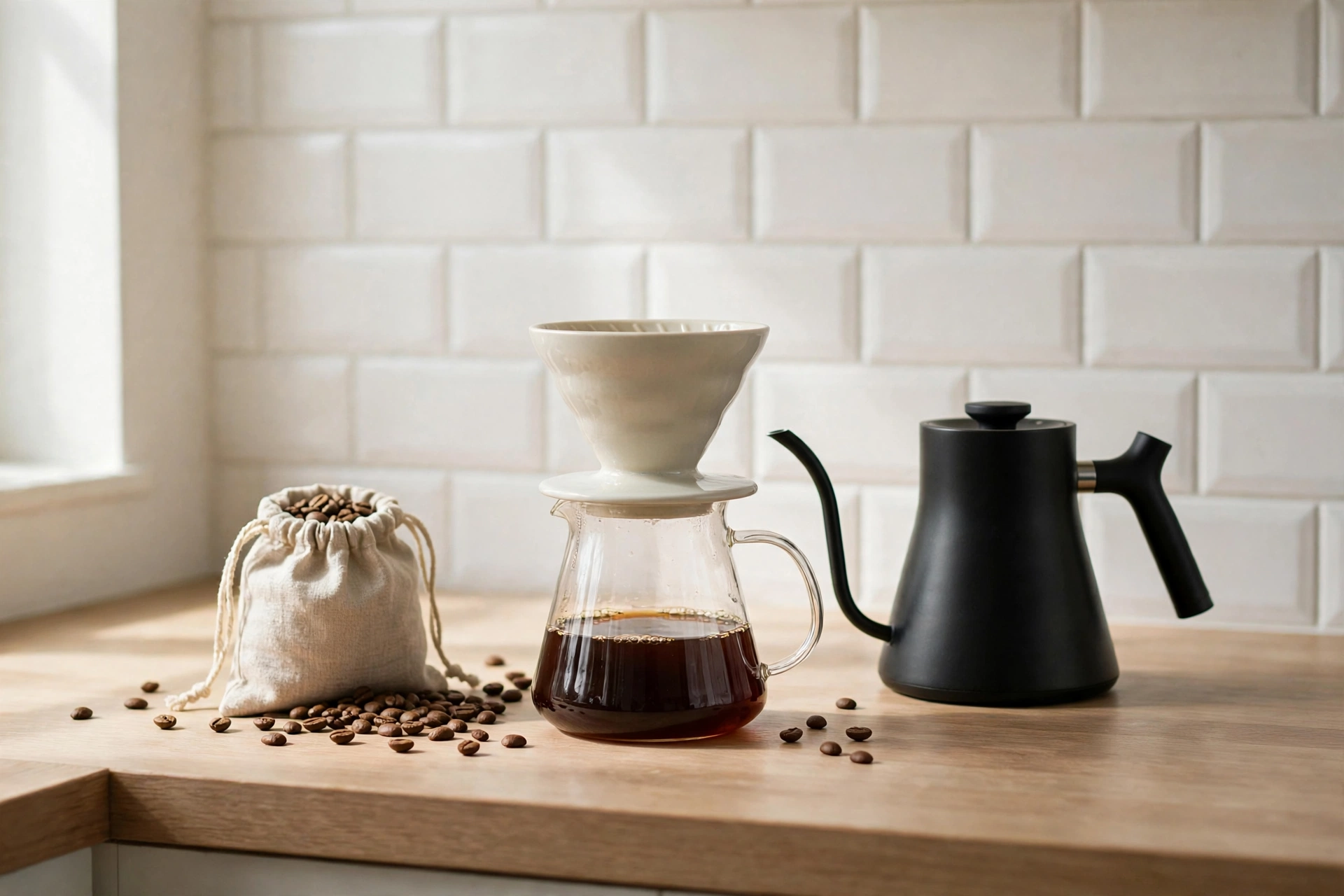
My mornings changed the day I stopped pressing one button and started pouring hot water in slow circles. Five minutes, the kitchen smells like a café, and the coffee tastes homemade.
That is what a good pour over does — and why picking the best pour over coffee maker feels harder than it should. They all look like simple cones and glass. The difference is the shape, the filter, and how much the brewer forgives you on a sleepy morning.
I spent weeks reading manufacturer guides and the roundups I trust — DripRoast, CoffeeGearHub, Daily Brewer — and comparing how each brewer actually behaves in a real kitchen. Not in a lab: in a kitchen where someone is half awake, the kettle is a little too hot, and the grinder is set a notch too fine. Here is what I found, and who each one is really for.
Jump to section (13)
- Our Top Picks — Best Pour Over Coffee Makers at a Glance
- How I picked these (and what I did not do)
- Before you buy: what actually matters
- The picks, one by one
- How to brew pour over (the recipe that works for most of these)
- The grinder and kettle matter more than the brewer
- Which one should you buy?
- Mistakes that ruin a good pour over (I made all of these)
- Troubleshooting: when the cup tastes wrong
- Manual vs automatic — an honest side-by-side
- Glass vs ceramic vs metal — what the material really does
- How to look after your brewer (so it lasts years)
- Frequently asked questions
Our Top Picks — Best Pour Over Coffee Makers at a Glance
| Pick | Best for | Typical price* | Why it made the list |
|---|---|---|---|
| Kalita Wave 185 | Best overall | $30–$40 | Forgiving, consistent, sweet cup |
| Hario V60 02 | Best for coffee lovers | $10–$15 | Most control, brightest flavour |
| Chemex 6-Cup Classic | Best for a crowd / best glass pour over | $45–$55 | Cleanest cup, brews for two or more |
| Clever Dripper | Best pour over coffee maker for beginners | ~$35 | Nearly foolproof |
| Bonavita Connoisseur 8-Cup (BV1901TS) | Best automatic pour over coffee maker | ~$190 | One touch, SCA-certified |
| OXO Brew 8-Cup | Best electric pour over coffee maker | ~$196 | Automatic, thermal carafe |
Prices are ranges reported in independent review roundups in November 2026. They are not verified on Amazon — please check the current price on Amazon before you buy.
How I picked these (and what I did not do)
I did not buy and lab-test every brewer for a month, and I will not pretend I did. These picks come from manufacturer specifications plus the roundups that test and compare brewers properly — DripRoast, CoffeeGearHub, Daily Brewer and The Decide Lab — cross-checked against each other. Where a brewer has a real downside, it is in the cons, not hidden.
What I did bring is the kitchen side: I have brewed pour over most mornings for years. A flat-bottom brewer forgives a wobbly pour; a steep cone does not.
Before you buy: what actually matters
Shape decides how hard it is
A cone with one big hole, like the V60, gives you all the control — and all the responsibility. Pour too fast and the water rushes through; grind too fine and it stalls. A flat-bottom brewer like the Kalita Wave spreads the water out and slows it down for you.
Filters are a running cost
Chemex filters are thick, bonded, and not cheap. Kalita Wave filters cost more per cup than standard cones — buy the real ones, the wavy shape is the design. V60 filters are thin, cheap, and sold everywhere. Budget for filters, not just the brewer.
Size is about your mornings, not the box
One or two cups? A V60 02 or a Kalita 185 is plenty. Brewing for the whole table? That is Chemex territory — the 6-cup is a 3-to-4 mug brewer. An automatic 8-cup serves a household without you standing at the counter.
Material: glass looks lovely, steel survives
Glass shows the coffee and looks beautiful on a shelf — and breaks if it meets the edge of the sink. Stainless steel and plastic survive drops and busy kitchens. Ceramic feels lovely but is heavy and breakable. (The full glass vs ceramic vs metal breakdown is further down — it matters more than most guides admit.)
The picks, one by one
1. Kalita Wave 185 — Best overall
Best for: almost everyone. If you only buy one, buy this.
The Wave is the brewer I recommend to friends who want good coffee without a hobby. Its flat bottom and three small drain holes spread the water evenly, so even a rushed pour extracts evenly. The cup is sweet and balanced — caramel and chocolate notes come through, and medium roasts shine.
My morning with it: 20 g coffee, medium grind, about 320 g water at 93°C (200°F), a 1:16 ratio. Bloom 30 seconds, pour in slow circles, done in about three minutes. When I have messed up the grind — a notch too fine — the Wave still gives me a drinkable cup. A V60 would have sulked.
Honest cons: Wave filters cost more than standard cones, and you need the right size (185 filters for the 185 brewer). It is also not the brewer for bright, fruity light roasts — the V60 does that better. Stainless steel is the durable choice; ceramic looks prettier but is heavier.
Get it if: you want a consistent daily cup with minimal fuss. Skip it if: you love tweaking every variable and want the brightest possible cup — look at the V60 instead.
2. Hario V60 02 — Best for coffee lovers who like control
Best for: the person who enjoys the ritual and wants the brightest cup for the least money.
The V60 is a steep 60-degree cone with one large hole and spiral ribs. It adds almost no resistance, so your pour decides everything. Done right — medium-fine grind, water at 93–96°C — it gives the clearest cup here: light roasts taste floral and fruity in a way the other brewers flatten out. The plastic version costs about $10–$15, the cheapest way into proper pour over.
It punished me the first week. Too fine and the single hole clogged; too coarse and the water rushed through in two minutes. Once I settled on a recipe — 20 g coffee to 320 g water, 1:16, bloom 45 seconds — it became my slow weekend brewer, for mornings when I actually want to pay attention.
Honest cons: the least forgiving brewer on this list — bad technique shows up in the cup. You will also want a gooseneck kettle and a scale, which adds cost, and the thin paper filters tear if you rush.
Get it if: you like light roasts, you enjoy learning technique, and you want maximum flavour for minimum money. Skip it if: you want good coffee before you have had coffee. The Kalita or the Clever Dripper will be kinder at 7 a.m.
3. Chemex 6-Cup Classic — Best for a crowd, and the best glass pour over coffee maker
Best for: slow weekend mornings, a table full of people, and anyone who wants the cleanest cup possible.
The Chemex is a one-piece borosilicate glass flask with a wooden collar, in the Museum of Modern Art since the 1940s — it really does look that good on a table. Its very thick bonded filter strips out more oils and fine grounds than any other brewer here, giving a tea-like, exceptionally clean cup. Light and smooth: some call it pure, others a little thin. Both are right.
Brewing for two or three takes four to five minutes: medium to medium-coarse grind, 1:15 to 1:16 ratio, water around 93°C. The ritual is slower, and that is the point. This is the brewer for a Saturday, not a Tuesday.
Honest cons: it is fragile glass, the filters are the most expensive here, and cleaning the narrow neck needs a long brush. It is also the slowest brewer on the list, and the wooden collar must come off before washing. Do not put it through sudden temperature shocks.
Get it if: you regularly brew for two or more, you love a clean, light cup, and you want a brewer that doubles as a centrepiece. Skip it if: you drink alone, you are in a rush, or your kitchen has a track record with glass.
4. Clever Dripper — Best pour over coffee maker for beginners
Best for: anyone who wants pour-over flavour with almost no way to mess it up.
The Clever Dripper looks like a V60 with a trick: a valve at the bottom holds the water in, so the coffee steeps like a French press, then you set it on your mug and it drains through a paper filter. That immersion step is why it is nearly foolproof. Uneven pour? Does not matter much. Grind a bit off? Still a good cup.
I wish this had been my first brewer — my early pour-over mornings would have been far less bitter. Medium grind, 1:15 ratio, water just off the boil, steep about three minutes, then release. Cleaning is a quick rinse, and the light Tritan plastic body does not break.
Honest cons: it is plastic, which some people dislike on principle, and the cup is a little less bright than a well-brewed V60. It only makes one or two mugs at a time, and you need its specific filters.
Get it if: you are a beginner, or you want great coffee on busy mornings without thinking. Skip it if: you want the brightest, most expressive cup, or you brew for a crowd.
Hario Switch — the immersion safety net
Best for: anyone who loves the V60's cup but not the V60's learning curve.
The Switch is a V60 with a valve at the bottom. Close the valve and the water stays in, steeping the grounds like a French press; open it and the coffee drains through the paper filter like a normal pour over. That one valve removes most of the technique: a wobbly pour or a slightly wrong grind barely matters while the valve is shut, because the coffee is steeping, not draining. CoffeeGearHub flags it as the low-technique pick for exactly this reason — it is the closest thing to a V60 that forgives you.
My take: if you want the V60's bright, clear cup but you are buying your first dripper, start here instead. Brew it closed for two or three minutes, then open the valve and let it drain. You get a cup very close to a well-brewed V60, with the Clever Dripper's safety net built in. It costs more than a plain plastic V60 and needs the same V60 filters, and the valve is one more part to rinse — but for a beginner who wants to grow into proper pour over, it is the smartest first buy on this page.
Get it if: you want V60 flavour without V60 punishment, or you like the Clever Dripper's idea but want a brighter cup. Skip it if: you already own a V60 and a Clever Dripper — the Switch sits between them, and you do not need all three.
Origami Air S — the travel pick (a note, not a ranked pick)
The Origami Air S is the one brewer in the roundups I read that I did not rank, because it is a specialist, not an all-rounder — but it is worth knowing about. It is a small, tough plastic dripper, around $30 in DripRoast's roundup, that takes both V60 cone filters and Kalita Wave flat-bottom filters, so one brewer gives you two brew styles. It is light, hard to break, and made for a bag, a camper van, or a desk drawer. If you travel and want real pour over on the road, this is the pick. At home, the Kalita or the V60 still wins.
5. Bonavita Connoisseur 8-Cup (BV1901TS) — Best automatic pour over coffee maker
Best for: households that want pour-over quality at the push of a button.
The Bonavita is the simplest automatic on this list: one touch, a pre-infusion bloom that wets the grounds before the full brew, and SCA certification — it holds water temperature around 200°F (93°C) through the whole brew. That temperature control is what most cheap drip machines fail at, and it is why this one tastes like pour over instead of like a hotel machine. The thermal carafe keeps coffee hot without a hot plate cooking it.
Mornings with it are gloriously boring in the best way. Fill, press, walk away. Eight cups is genuinely enough for a family or a small gathering.
Honest cons: it is the plainest machine here — no timer, no strength settings, no app. At around $190 it is a real purchase, not an impulse buy, and it takes up counter space. Descaling matters if you have hard water.
Get it if: you want great coffee with zero morning effort, and you brew for more than one person. Skip it if: you enjoy the manual ritual, or you only make one mug — a manual brewer costs a tenth of this.
6. OXO Brew 8-Cup — Best electric pour over coffee maker
Best for: someone who wants the automatic ease of the Bonavita with a little more polish.
The OXO Brew 8-Cup is also SCA-certified, with the same proper temperature and a pre-infusion bloom, plus a thermal carafe and a cleaner, more modern look on the counter. In the roundups I read it kept coming up as the value pick among certified machines — reliable temperature, good build, roughly half the price of the premium machines in this category. The difference from the Bonavita is small and honest: similar coffee, slightly different design and feel, around $196 in recent roundups. If the Bonavita feels too plain, the OXO is the prettier twin.
Honest cons: same as any automatic — close to $200, it lives on your counter, and it will not teach you pour-over technique. If it ever needs repair, it is a machine, not a $15 cone you can replace.
Get it if: you want a certified automatic brewer that looks good in a modern kitchen. Skip it if: a manual brewer would do — or the Bonavita is cheaper when you check the live price.
How to brew pour over (the recipe that works for most of these)
- Ratio: 1:15 to 1:16 — 20 g coffee to 300–320 g water. More water makes a lighter cup; less makes it stronger.
- Grind: medium-fine for the V60, medium for the Kalita Wave and Clever Dripper, medium to medium-coarse for the Chemex. Bitter means grind coarser; sour or weak means grind finer.
- Water: 92–96°C (198–205°F). Just off the boil is fine — let a boiled kettle sit for 30 seconds.
- Bloom: pour just enough water to wet the grounds, wait 30–45 seconds. The coffee will puff up. This is the step most people skip, and it fixes most bitter cups.
- Preheat the brewer: rinse the paper filter with hot water and let the hot water warm the dripper before you add the grounds. This is essential for ceramic and glass brewers — they steal heat in the first 30 seconds — and optional for plastic, which barely loses any. Pour the rinse water away before brewing.
- Pour: slow circles, keeping the water level steady. Around 3 minutes for a single cup, 4–5 for a Chemex batch.
The grinder and kettle matter more than the brewer
I said it in the spend order above and I will say it again, because this is the part most guides skip: a burr grinder and a gooseneck kettle will improve your coffee more than any brewer upgrade. These are the picks the roundups I read keep recommending. All prices below are ranges reported by DripRoast in November 2026 and are not verified on Amazon — please check the current price on Amazon before you buy.
Grinder picks (competitor-reported)
- Kingrinder K6, around $100 (hand grinder). The budget pick if you do not mind thirty seconds of arm work. Hand grinders grind as evenly as electrics costing twice as much, and this one is the one DripRoast recommends for pour over.
- Baratza Encore ESP or Fellow Opus, $150–$180 (electric). The sensible electric step up. Both grind fine enough for pour over and coarse enough for cold brew, so one grinder covers both methods in this guide.
- Fellow Ode Gen 2, around $300 (electric). The premium pick. Beautiful, quiet, and built for filter coffee specifically. Lovely — but buy it only after you have the brewer and the habit, not before.
One honest rule: a $15 V60 with freshly ground beans beats a $190 automatic machine with pre-ground supermarket coffee, every time. Grind fresh, grind right, and the brewer barely matters.
Kettle picks (competitor-reported)
- Fellow Stagg EKG, around $150–$180. The benchmark gooseneck: precise pour, holds temperature, looks lovely. If you buy one kettle and keep it for a decade, this is the one.
- A $40–$60 budget gooseneck. DripRoast's point is blunt and correct: a budget gooseneck pours just as slowly and steadily as the expensive one. Temperature control is nice, not mandatory — a kettle just off the boil, left to sit for 30 seconds, is 93–96°C, which is where you want to be.
- What you actually need: a thin, controllable spout. A normal kettle pours too fast for a V60 and floods the bed. For the Kalita Wave or Clever Dripper you can get away with a normal kettle, because the brewer forgives a fast pour.
Buy in this order: burr grinder first, then a scale, then a gooseneck kettle — and only then a prettier brewer.
Which one should you buy?
If you want one answer: get the Kalita Wave 185 — the most forgiving, the most consistent, the one you will still be using in a year. Love light roasts and the ritual? Hario V60 02 — it costs less than a bag of good beans. Brewing for a table? Chemex. Half asleep? Clever Dripper. Want it automatic? Bonavita for simplicity, OXO for polish. The wrong choice here costs about thirty dollars. The right one gives you five quiet minutes every morning that feel like yours.
Mistakes that ruin a good pour over (I made all of these)
Skipping the bloom. Dry grounds release carbon dioxide when hot water hits them, and that gas pushes water away from the coffee — uneven extraction, sour cup. Wet the grounds with about 50 g of water, wait 30–45 seconds until they puff and settle, then keep pouring. Half a minute, and it fixes more bad cups than any new brewer will.
Grinding wrong. Pour over lives in the middle. Too coarse and the water falls through in ninety seconds — weak, sour coffee. Too fine and the bed chokes, the brew stalls, everything tastes bitter. Sour means grind finer; bitter and dry means grind coarser. One notch at a time. I once changed grind, ratio and temperature all in one morning and learned nothing, because I could not tell which change did what.
Boiling water straight onto the grounds. Water at a rolling boil is around 100°C and pulls out the bitter compounds first. Let the kettle sit for 30 seconds, or use 93–96°C.
Pouring in one big dump. Dumping all the water at once floods the bed and the water finds the fastest path down instead of passing through the coffee. Slow circles, keeping the water level just above the bed. It feels fussy the first week; by the second it is muscle memory.
Skipping the rinse, or reusing a filter. A dry paper filter tastes like paper — rinse it with hot water first and throw the rinse water away. Never reuse a filter. Thirty seconds, and a used filter is a stale cup.
Troubleshooting: when the cup tastes wrong
Most bad pour over is one of three problems, and each one has a fix you can try tomorrow morning. Change one thing at a time, or you will never know what fixed it.
Sour, thin, or weak — under-extraction. The water rushed through before it pulled the flavour out. Fix it by grinding finer, pouring more slowly, or using slightly hotter water. A V60 that drains in under two minutes is almost always this problem.
Bitter, dry, or harsh — over-extraction or channelling. The water spent too long with the grounds, or it found a fast channel through the bed and over-extracted one part of it while the rest stayed dry. Fix it by grinding coarser and pouring more gently, in slow circles, keeping the water level steady. Channelling often comes from pouring too hard in one spot — spread the pour out.
The brew stalls and will not drain — a stuck bed. Too fine a grind is the usual cause, but the filter matters too. DripRoast's fix list: switch to a faster-draining paper — Cafec Abaca or Sibarist papers drain noticeably quicker than standard V60 filters — and check for a Chemex vapour lock, where the thick filter seals against the glass neck and traps air underneath; lifting the filter slightly or using the pouring spout breaks the seal. A stainless steel Kalita Wave can also stall if the flat filter suctions against the drain holes — the ceramic and glass Waves have ribs that stop this.
If the cup is sour one day and bitter the next with the same beans, your grind is uneven or your pour is inconsistent — and that is a grinder problem, not a brewer problem. See the grinder picks above.
Manual vs automatic — an honest side-by-side
| Manual (V60 / Kalita / Chemex / Clever) | Automatic (Bonavita / OXO) | |
|---|---|---|
| Morning effort | 5 minutes, standing at the counter | Fill, press, walk away |
| Control | Total — grind, temp, pour speed | Little — the machine decides |
| Best cup possible | Higher, if your technique is good | Very good, every single time |
| Worst cup possible | Sour or bitter, if you rush | Rarely bad, rarely extraordinary |
| Cost | $10–$55 for the brewer | ~$190–$196 |
| Who it suits | Slow mornings, coffee lovers, one or two mugs | Families, busy mornings, 6–8 cups |
My strong opinion: one mug and you enjoy the ritual? A manual brewer beats an automatic every time — and costs a tenth as much. Coffee for three people before school and work? Buy the automatic and never feel guilty. The best brewer is the one you actually use on a Tuesday.
Glass vs ceramic vs metal — what the material really does
Plastic insulates, glass loses some heat, ceramic absorbs it, and steel radiates it away. In plain terms: a plastic V60 keeps your slurry hotter than a ceramic V60, which is why the $12 plastic version often brews better than the $40 ceramic one. Ceramic feels premium but steals heat in the first 30 seconds — exactly when extraction matters most — unless you preheat it with a full kettle of hot water.
Glass sits in the middle: beautiful, less heat loss than ceramic, but fragile. Stainless steel is toughest and travels best, but DripRoast warns the steel Wave's flat bottom can suction the filter against the drain holes and stall the brew — the ceramic and glass Waves have ribs that stop this. So: plastic for performance, ceramic or glass for the table, steel for travel.
How fast each material pulls heat away is measurable, and the gap is bigger than most people expect. DripRoast's thermal conductivity figures (in watts per metre-kelvin, W/m·K — higher means heat escapes faster):
| Material | Thermal conductivity (W/m·K) | What it means at the counter |
|---|---|---|
| Plastic | ~0.1–0.2 | Barely steals any heat — the most forgiving material |
| Glass | ~1.1–1.4 | Loses some heat, but far less than ceramic |
| Ceramic | ~3.0–4.0 | Absorbs a real amount of heat in the first 30 seconds |
| Stainless steel | ~14–16 | Sheds heat fastest — needs a preheat or a fast pour |
That is why the $12 plastic V60 often brews a better cup than the $40 ceramic one: the ceramic is drinking your heat before the coffee gets it. It is not about quality — it is physics, and the table above is the reason the cheap plastic version keeps winning in the roundups.
How to look after your brewer (so it lasts years)
Manual brewers are nearly indestructible: rinse after every brew, wash with warm soapy water, air-dry. A Chemex needs a long bottle brush for the narrow neck — buy it with the brewer. Remove the wooden collar before washing, and never plunge a hot Chemex into cold water.
Automatic machines need descaling every two to three months, more often with hard water. Follow the manual's exact cycle — scale kills heating elements, and a scaled machine brews cooler until the coffee tastes flat and you blame the beans. Wipe the carafe lid and brew basket weekly; old coffee oils go rancid, and that stale taste is not the beans either.
Frequently asked questions
Is pour over coffee better than drip coffee?
It can be, because you control the water temperature, the pour, and the timing — and certified automatic brewers like the Bonavita and OXO do the same thing. A cheap drip machine brews too cool and too fast. But a pour over brewed badly tastes worse than a decent drip machine, so technique matters.
What grind size should I use for pour over?
Medium-fine for a V60, medium for a Kalita Wave or Clever Dripper, and medium to medium-coarse for a Chemex. Start there and adjust by taste: bitter means go coarser, sour or weak means go finer. Change one thing at a time or you will never know what fixed it.
Do I need a gooseneck kettle for pour over?
It helps a lot with the V60 and Chemex, where a slow, controlled pour matters. For the Kalita Wave and Clever Dripper you can get away with a normal kettle. If you buy one thing after your brewer, make it a scale first, then a gooseneck kettle, then a burr grinder.
How do I clean a pour over coffee maker?
Rinse paper filters out after every brew and wash the brewer with warm soapy water. Glass Chemex flasks need a long bottle brush for the narrow neck. Descale an automatic machine like the Bonavita or OXO every few months, especially with hard water — the manual will tell you how, and it is worth doing.
Manual or automatic pour over — which should I buy?
It comes down to your mornings, not your coffee knowledge. Manual if you make one or two mugs and enjoy five quiet minutes — best cup for $10–$55. Automatic if you brew for a household and you are out the door at 7:30 — a very good cup with zero effort. The serious choice is the one you will still use in six months.
How much should I spend on a pour over coffee maker?
Less than you think. A plastic V60 at $10–$15 plus a scale makes better coffee than a $60 ceramic dripper used badly. Spend in this order: burr grinder first, then a scale, then a gooseneck kettle — and only then a prettier brewer. The $190 automatics are worth it only if you genuinely need 8 cups at the push of a button. For most kitchens, $30–$55 total is the sweet spot.
Glass, ceramic or plastic — does the material change the taste?
Yes — see the "Glass vs ceramic vs metal" section above for the full breakdown. Short version: buy plastic for the cup, ceramic or glass for the table, steel for travel.



One Comment