Easter Crafts and Activities for Kids
Easter is one of the easiest holidays to fill with hands-on fun. The season brings bunnies, chicks, painted eggs, and the first warm days of spring, so there is no shortage of ideas to try at the kitchen table or out in the yard. This guide gathers the best of them in one place: egg decorating, simple crafts, egg hunts, learning games, and outdoor activities, all for children aged 2 to 10.
Easter 2027 falls on Sunday, March 28, which gives you the whole week before to spread the activities out. Most of the ideas below need very little preparation and use supplies you probably already have at home, like paper plates, paint, crayons, and an old egg carton. Pick a few favorites, keep the mess manageable, and let the kids lead.
Jump to section (10)
Egg decorating
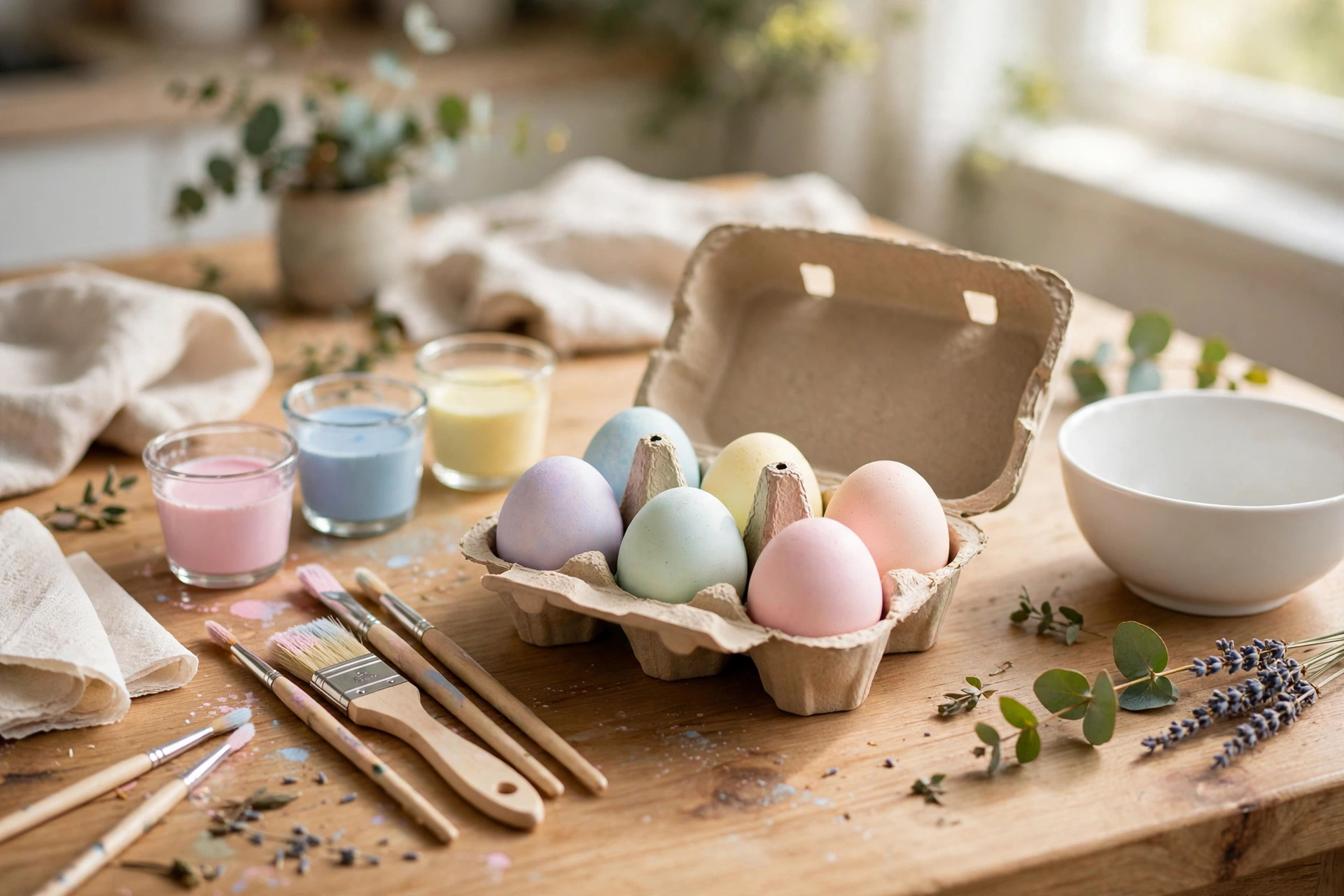
Decorating eggs is the classic Easter activity, and there is a method that works for every age. Choose the one that matches your child’s patience level and your tolerance for mess.
Wax resist with crayons. This one feels a little like magic. Let your child draw on a warm hard-boiled egg with a white crayon, then dip the egg in dye. The dye colors the shell everywhere except where the wax is, so the drawing shows up white against the color. An adult should handle the hot eggs and the dye bath.
Food coloring dye. You do not need a store-bought kit. Stir half a cup of hot water, a teaspoon of white vinegar, and about 20 drops of food coloring together in a cup or small bowl, then lower a hard-boiled egg in and leave it for a few minutes. Lift it out with a spoon and let it dry on a rack or in an empty egg carton. Deeper colors come from a longer soak or a few extra drops of coloring.
Stickers and markers. For toddlers, this is the simplest option of all. Give them a boiled egg, a sheet of small stickers, and some washable markers, and let them decorate without any dye or water involved. The eggs still look festive, and cleanup takes seconds.
Paper eggs. If you would rather skip boiling eggs altogether, cut egg shapes from white card or heavy paper. Children can color them with crayons, markers, or paint, add patterns, and then tape them to a window or string them up as a garland. They keep well, so you can bring them out again next year.
Plastic eggs. A pack of plain plastic eggs can be decorated with washi tape, stickers, and small stick-on gems. Unlike real eggs, they can be used again every Easter, and children can fill them with treats for the hunt afterward.
A quick note on safety: if you plan to eat the decorated eggs, keep them refrigerated, use food-safe dyes, and do not leave them sitting out at room temperature for hours while children admire them. Eggs that have been out on display all afternoon belong in the trash, not on the dinner table.
Easter crafts

A few paper plates, some cotton balls, and a spare egg carton can keep children busy for an afternoon. These crafts are simple enough for young kids and open-ended enough that older children can add their own details.
Paper plate bunny. Paint a paper plate white or pink and let it dry. Cut two long ears from colored paper and glue them to the top, then add a pom-pom nose, paper whiskers, and drawn-on eyes. A plate with the bottom cut away also makes a sweet bunny face mask with ribbon ties.
Cotton ball bunny tail. Draw a bunny from behind on a sheet of paper, just the round body and the ears peeking over the top, then glue a fluffy cotton ball on as the tail. It is a quick five-minute craft that toddlers love because they get to touch something soft.
Handprint chicks. Paint a child’s hand yellow, press it onto paper, and let it dry. The fingers become the chick’s fluffy feathers. Add an orange paper triangle for the beak, two eyes, and thin orange legs, and you have a keepsake parents tend to save.
Egg carton chicks. Cut individual cups from a cardboard egg carton, paint them yellow, and add a paper beak, eyes, and little feet cut from orange card. They stand up on their own, so they work well as table decorations or as part of a spring display on a windowsill.
Bunny ears headband. Cut two tall ears from card, decorate them with a pink inner ear, and staple or glue them to a strip of paper sized to fit around your child’s head. Children can wear them for the egg hunt, for photos, or just around the house.
Easter basket. Turn a paper bag or a small box into a basket with paint, stickers, and a paper handle. It is more personal than a store-bought basket, and children take real pride in carrying something they made themselves to the egg hunt.
Easter cards. Fold a sheet of card in half and let children decorate the front with a bunny, a chick, or a painted egg. Grandparents and relatives love receiving a handmade card in the mail, and it gives older children a reason to practice writing a short message inside.
Spring flower garland. Color and cut out paper flowers, then thread them onto a length of string or ribbon. Hang the garland across a doorway or along a mantel for a cheerful spring decoration that lasts well past Easter weekend.
Egg hunts

An egg hunt can be as simple or as elaborate as you like. The trick is to match the difficulty to the age of the children taking part, so nobody ends up frustrated or bored.
For toddlers, keep every egg in plain sight, at their eye level, in a small area like one room or a corner of the yard. They will enjoy spotting the bright colors without needing to search behind anything.
For preschoolers, hide eggs in easy places and give each child a color to find. That way every child ends up with the same number of eggs, and there is no race to grab them all first.
For older kids, raise the challenge. Write clue cards or riddles that lead from one hiding spot to the next, or put a letter inside each egg so that the letters spell a word once they are all collected. A treasure map drawn on paper works well too.
Indoor hunt. Rain does not have to cancel the fun. Hide paper eggs or plastic eggs around the house, in drawers, under cushions, and on bookshelves. Smaller spaces actually make the game feel more exciting.
Counting hunt. Put a number inside each egg and have children add up their totals when the hunt is over. The child with the highest total wins a small prize, or everyone works together to reach a combined target number. It turns a game into a quiet bit of math practice without anyone noticing.
Easter learning activities
Easter themes make learning feel like play. These activities build early math, observation, and science skills while children are busy having fun.
Egg counting. Count eggs into baskets in groups of two, five, or ten, then make a simple picture graph showing how many eggs of each color were found. Younger children can sort eggs by color first, then count each pile.
Patterns. Decorate eggs with repeating patterns of stripes, dots, and zigzags, and ask children to continue a pattern you start. Making a pattern is one of the earliest math skills, and eggs are a perfect surface for practicing it.
Easter I Spy. Print or draw a busy Easter scene filled with bunnies, chicks, and eggs, and ask children to count how many of each they can find. It builds careful looking and counting in one go.
Seasonal math. Spring and Easter themed math worksheets, like adding up baskets of eggs or coloring a picture by solving sums, keep practice fresh. Children who resist ordinary worksheets often enjoy the same problems when they are dressed up for the holiday.
Life cycle of a chicken. Easter is a natural time to talk about where chicks come from. Draw the three stages together, egg, chick, and chicken, and talk about what happens at each step. Older children can write a sentence about each stage.
Egg drop challenge. For children aged 7 and up, the egg drop is a favorite. Each child designs a container from paper, cotton, straws, or bubble wrap to protect a raw egg, then the eggs are dropped from a height to see which designs survive. It is simple science, and it always gets a big reaction.
Spring nature activities
Easter arrives just as the natural world is waking up, so take some of the fun outside. Go for a spring walk and look for the signs of the season together: buds opening on trees, the first blossoms, birds carrying nesting material, and new lambs in the fields.
Planting seeds is another good fit for the week. Cress grows fast enough for young children to see results in a few days, and beans are satisfying because they grow tall and visible. Give each child a small pot, some soil, and a few seeds, and let them take responsibility for watering.
Back at home, color spring flowers or press a few real ones between the pages of a heavy book. A walk, a planting project, and a coloring page together make a gentle afternoon that balances the excitement of the egg hunt.
Ideas by age
The right activity depends a lot on how old your child is. Here is a quick guide to matching ideas to ages.
Ages 2 to 3: sticker eggs, handprint chicks, simple egg hunts where every egg is in plain sight, and cotton ball bunnies. Keep each activity short, around ten minutes, and expect a fair amount of mess.
Ages 4 to 6: paper plate bunnies, egg carton chicks, dyeing eggs with an adult’s help, and counting hunts where they add up the numbers inside their eggs. Children this age enjoy having a finished craft to show off.
Ages 7 to 10: wax resist eggs, clue hunts with riddles, the egg drop challenge, and designing their own Easter cards with written messages. Older children like a challenge and a bit of independence, so let them plan part of the hunt themselves.
Easter traditions around the world
Easter is celebrated in different ways in different places, and talking about those traditions is a lovely way to help children learn about other cultures.
In some European countries, families decorate trees or branches with painted eggs, hanging them like ornaments. In Greece, eggs are traditionally dyed red, a color with deep meaning in the Orthodox tradition. And egg rolling, where hard-boiled eggs are rolled down a hill to see whose travels furthest without cracking, is a tradition in parts of the UK and the USA. The White House has hosted an egg roll for more than a century.
You can bring one of these traditions into your own home. Dye a few eggs red and talk about why, or find a gentle slope in a park and hold a family egg rolling race. It turns a craft afternoon into a small lesson about the wider world.
Common mistakes to avoid
A little planning goes a long way. These are the mistakes families make most often.
Hiding eggs too well. Children get frustrated quickly when they cannot find anything. Keep a written list of where every egg is hidden, and do a quick count at the end to make sure none are left behind in the garden.
Too much chocolate at once. A basket full of chocolate on Sunday morning often ends with a sugar crash by lunchtime. Spread the treats over a few days, or swap some of the chocolate for small toys, books, or activity ideas.
Hot eggs for little hands. Freshly boiled eggs stay hot for longer than you expect. Let them cool completely before handing them to young children, and do the boiling and dye mixing yourself.
Trying to do everything in one day. Easter works better spread across the week. Dye the eggs one day, make the crafts another, and save the hunt for the weekend. Children enjoy each activity more when they are not rushed from one to the next.
Frequently asked questions
When is Easter?
Easter falls on a Sunday in March or April, and the date changes every year because it is set by the lunar calendar. In 2027, Easter Sunday is March 28. The week leading up to it, starting Monday, March 22, is a good time to plan your crafts and activities.
How do I dye eggs without a kit?
You do not need a kit. Mix half a cup of hot water, a teaspoon of white vinegar, and about 20 drops of food coloring in a cup, then dip a hard-boiled egg in for a few minutes. Dry the egg on a rack or in an empty egg carton. For deeper color, leave the egg in longer or add a few more drops of coloring.
What can I put in plastic eggs instead of chocolate?
Plenty of things. Stickers, small toys, puzzle pieces, coins, and notes with jokes or activity ideas all work well. Activity slips are a favorite: write things like “Have a dance party” or “Read a story together” on small pieces of paper and tuck one inside each egg.
An Easter week plan
If you like to plan ahead, here is a simple week of activities leading up to Easter Sunday, March 28, 2027.
Monday, March 22: go on a spring walk to look for signs of spring, and plant cress or bean seeds in small pots.
Tuesday, March 23: make paper plate bunnies and handprint chicks.
Wednesday, March 24: decorate eggs, using the dye, sticker, or wax resist method.
Thursday, March 25: make Easter cards for family and build egg carton chicks.
Friday, March 26: check on the planted seeds, color spring flowers, and prepare the egg hunt by filling plastic eggs.
Weekend, March 27 to 28: hold the egg hunt, play Easter I Spy, and enjoy a relaxed Easter Sunday together.
Can we do an egg hunt without chocolate?
Yes, absolutely. Fill plastic eggs with stickers, small toys, puzzle pieces, or activity slips like “Have a dance party” or “Build a tower with blocks.” Children enjoy the surprise of opening each egg just as much, and parents avoid the sugar rush. A hunt without chocolate also works well for children with allergies or dietary restrictions, since every egg is safe for every child.