26 Snack Organization Ideas for 2026
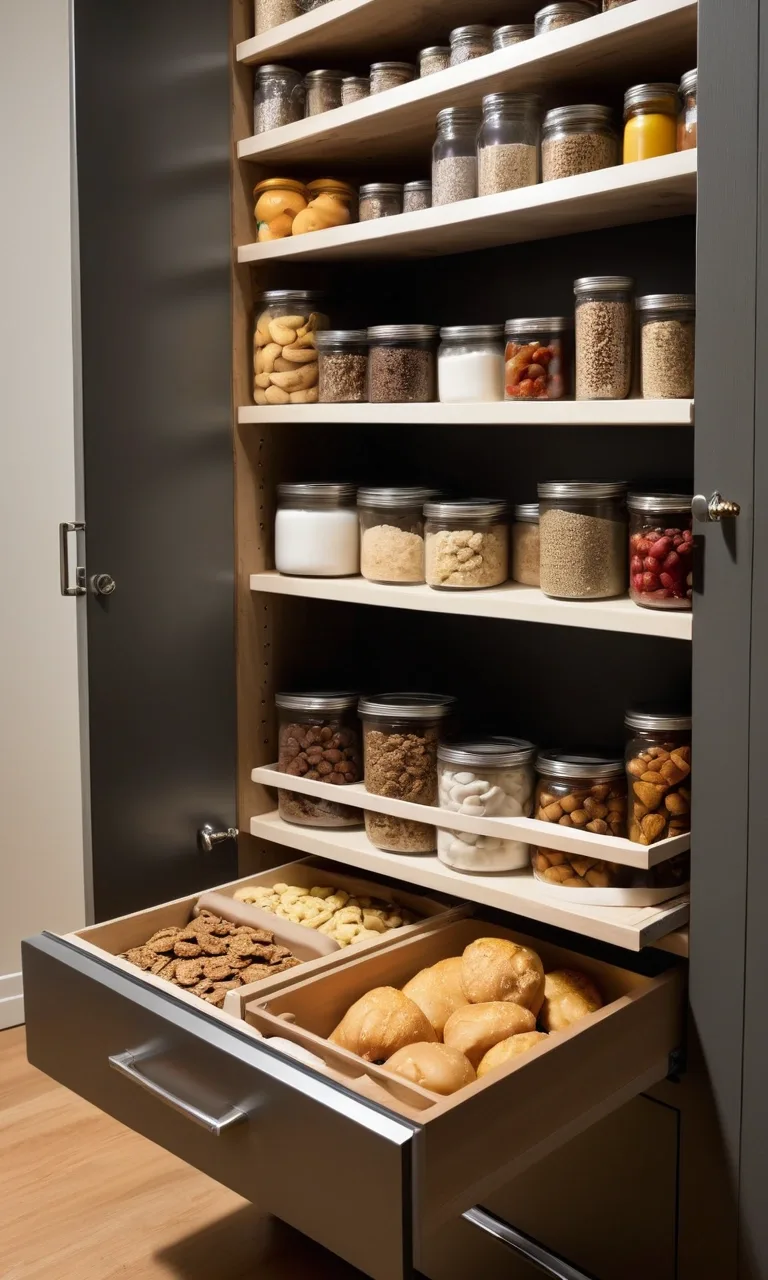
Keeping snacks organized can make a surprising difference in how your kitchen looks and functions. Whether you have a spacious pantry or a few crowded cabinets, finding the right storage system helps eliminate clutter and makes everyday snacking more convenient.
From individually wrapped treats to crackers, chips, and granola bars, snack packages come in different shapes and sizes. Without designated storage, they can quickly take over drawers, shelves, and countertops.
Fortunately, you don't need an expensive pantry makeover to create a practical setup. A few containers, thoughtful arrangements, and simple storage habits can completely transform your snack area.
These 26 snack organization ideas will help you make better use of available space while keeping your favorite foods accessible, fresh, and easy to find.
How to Organize Snacks?
Begin by removing all snacks from their current storage locations. Check expiration dates, discard anything stale, and gather unopened packages that have been scattered throughout the kitchen.
Next, organize everything into categories that make sense for your household. You might separate school snacks, salty treats, sweet options, protein bars, and individually packaged foods.
Choose containers according to the dimensions of your shelves and drawers. Transparent bins are especially useful because you can check your supplies without opening every container.
Place frequently eaten snacks within comfortable reach, while keeping occasional treats and extra supplies in less accessible areas. Store foods according to their packaging instructions, and use airtight containers for items that need protection from moisture.
The goal is to create an arrangement that everyone can understand and maintain without constantly reorganizing the kitchen.
1. Snack Drawer
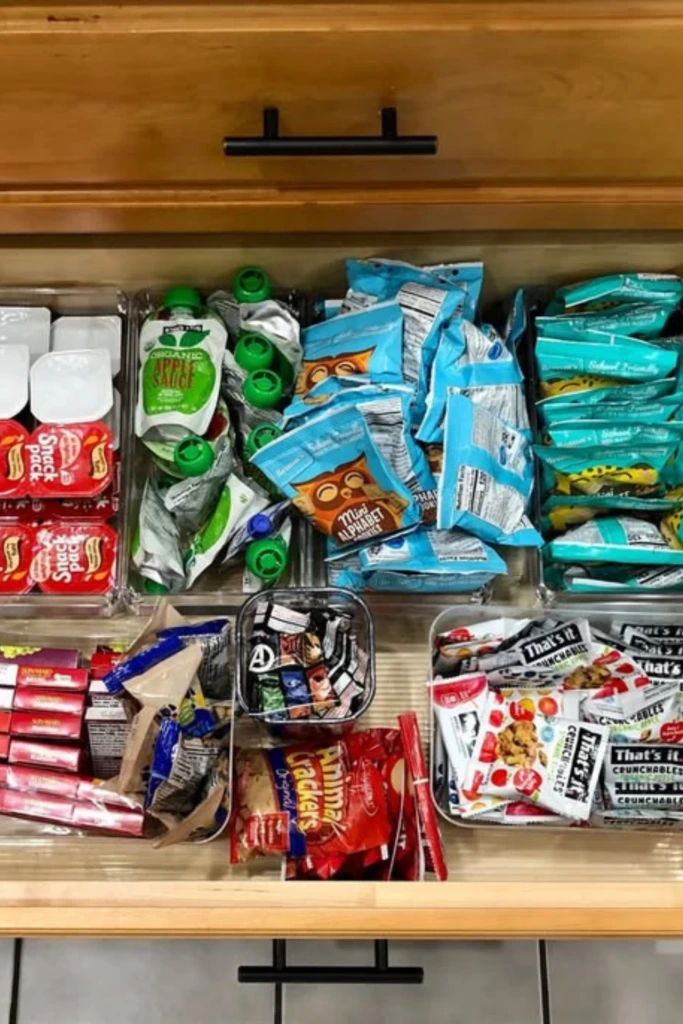
A dedicated snack drawer is an excellent way to keep everyday treats accessible without sacrificing valuable countertop space.
Choose a drawer near your pantry or food preparation area and add several removable organizers. Arrange packaged crackers, granola bars, and small snack bags in separate compartments.
Shallow dividers prevent smaller items from disappearing beneath larger packages. For households with children, a lower drawer can make age-appropriate snacks easier to reach independently.
Measure the drawer before purchasing organizers so everything fits comfortably and the drawer closes without catching on tall packages.
2. Flavor Rows
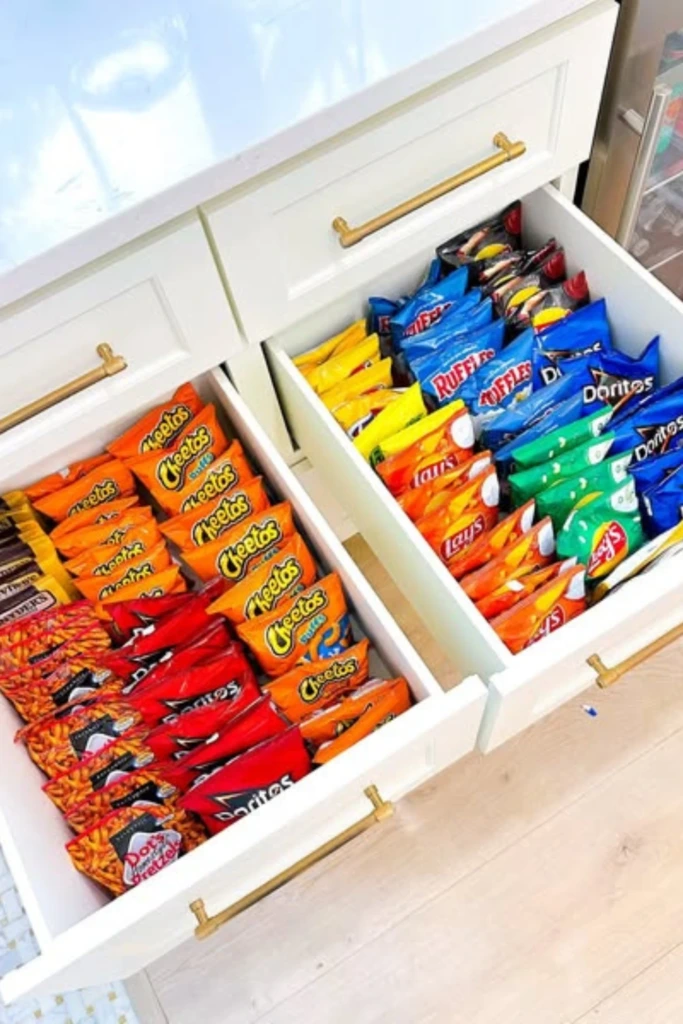
Organizing snacks by flavor makes choosing a favorite much easier, especially when your household regularly purchases several varieties of chips or crackers.
Create individual sections for flavors such as cheese, barbecue, sour cream, or spicy varieties. Upright storage keeps package fronts visible and prevents bags from piling on top of one another.
Adjustable dividers work particularly well because you can change the width of each section as your snack selection changes.
This arrangement also makes it easier to notice which flavors are running low before your next shopping trip.
3. Label Swap
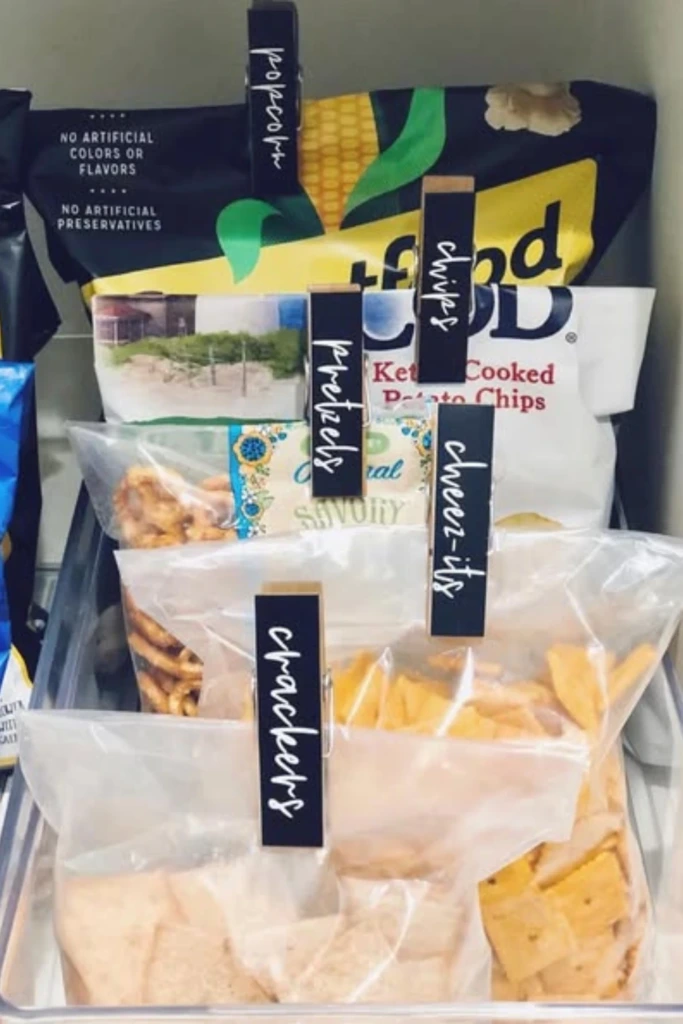
Replacing oversized snack boxes with compact, clearly labeled storage can free up considerable room in crowded cabinets.
Transfer individually wrapped snacks into reusable containers or food-safe storage bags. Add labels identifying the contents, particularly when several products look similar.
For unpackaged foods, include the expiration or best-before date and any important preparation information. Keep original packaging information when necessary for ingredients, allergens, and storage directions.
Avoid combining different batches without checking their dates. A simple labeling routine helps maintain freshness while giving your storage area a cleaner appearance.
4. Bar Lines
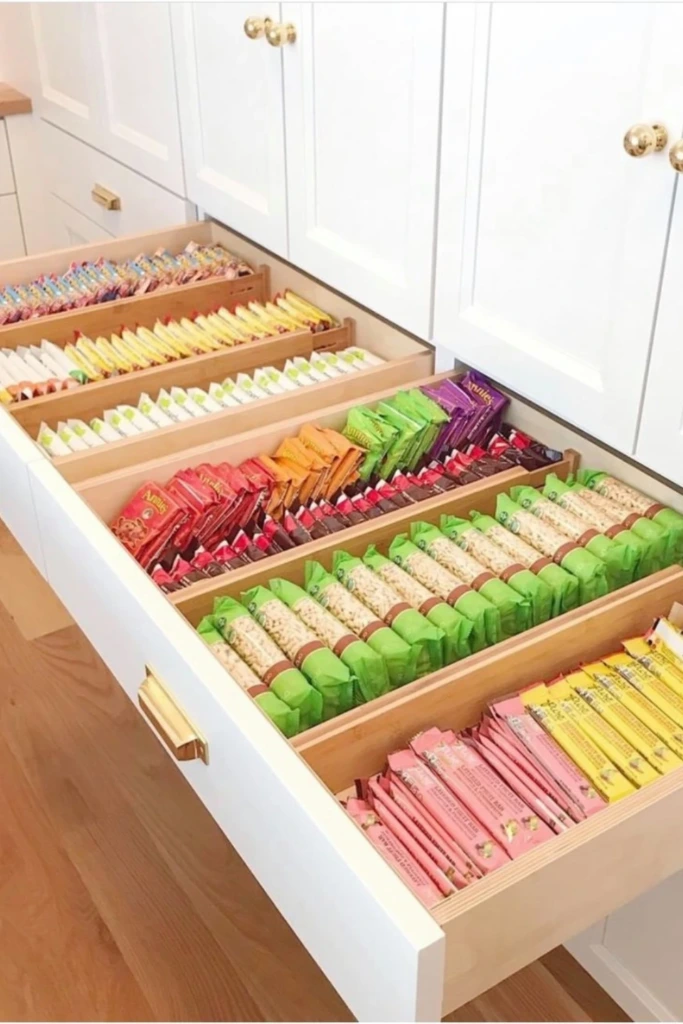
Granola bars, breakfast bars, and protein snacks are easier to manage when arranged in neat rows instead of scattered throughout a drawer.
Use long, narrow organizers to separate different varieties. Position each bar so its wrapper remains visible, allowing family members to identify their preferred options immediately.
If your drawer is deep enough, standing the bars upright can improve visibility and increase usable storage space.
Keep newly purchased bars behind older ones to encourage using existing supplies first. This simple arrangement makes packing lunches and grabbing breakfast on busy mornings much faster.
5. Drawer Zoning
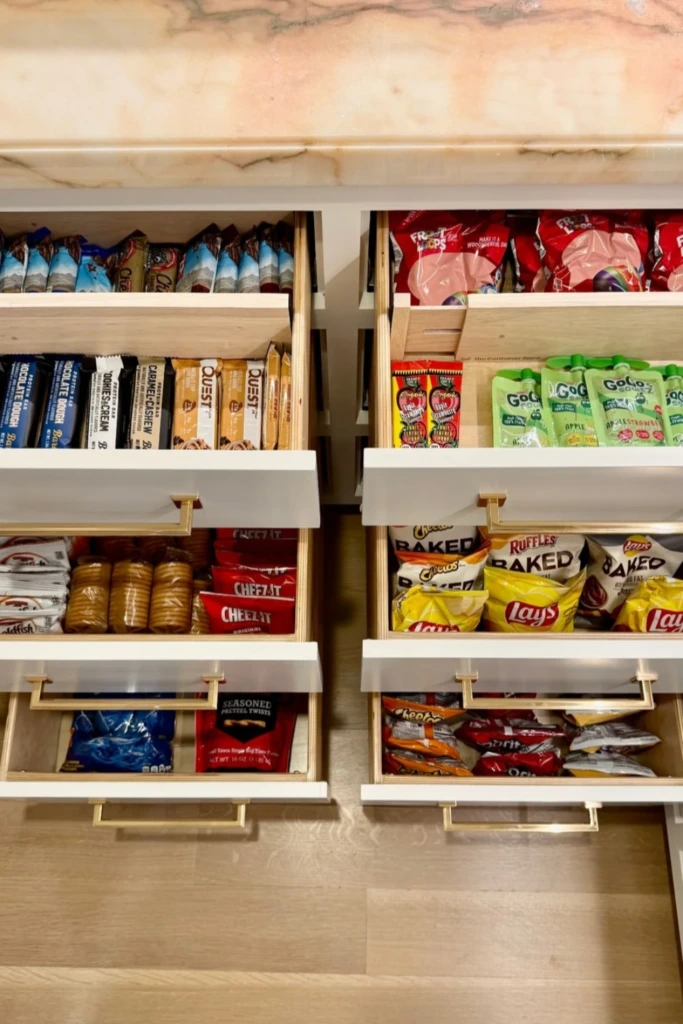
If your kitchen has multiple available drawers, assigning different purposes to each one can create an efficient snack storage system.
Reserve an upper drawer for lightweight items such as fruit snacks, cereal bars, and crackers. Use a deeper lower drawer for larger chip bags, popcorn packages, and bulkier treats.
Within each drawer, add small organizers to prevent unrelated items from mixing.
This method is particularly helpful in kitchen islands, where several drawers can become a convenient snack station without taking over the main pantry.
6. Clear Grid
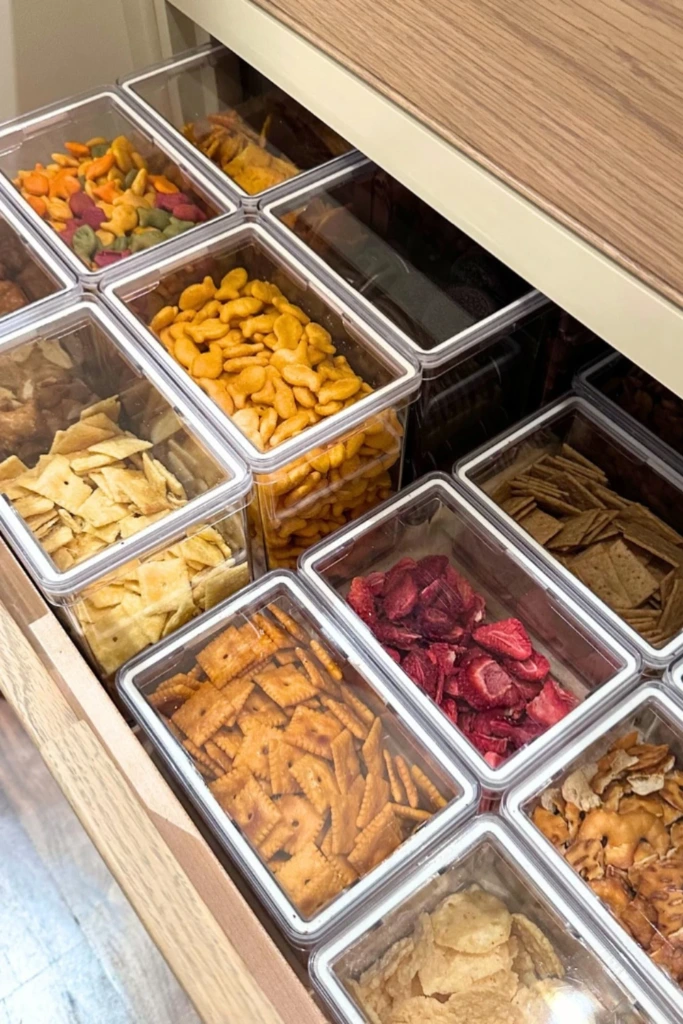
A grid of transparent containers gives loose snacks their own designated spaces while creating a tidy, coordinated appearance.
Choose rectangular or square food-safe containers that fit closely together inside a deep drawer. Fill them with suitable dry foods such as pretzels, crackers, nuts, or cereal.
Select airtight lids when storing products removed from their original packaging. This helps limit exposure to air and moisture.
Containers with similar dimensions are easier to arrange efficiently, and their transparent sides make it simple to identify items that need replenishing.
7. Daily Portions
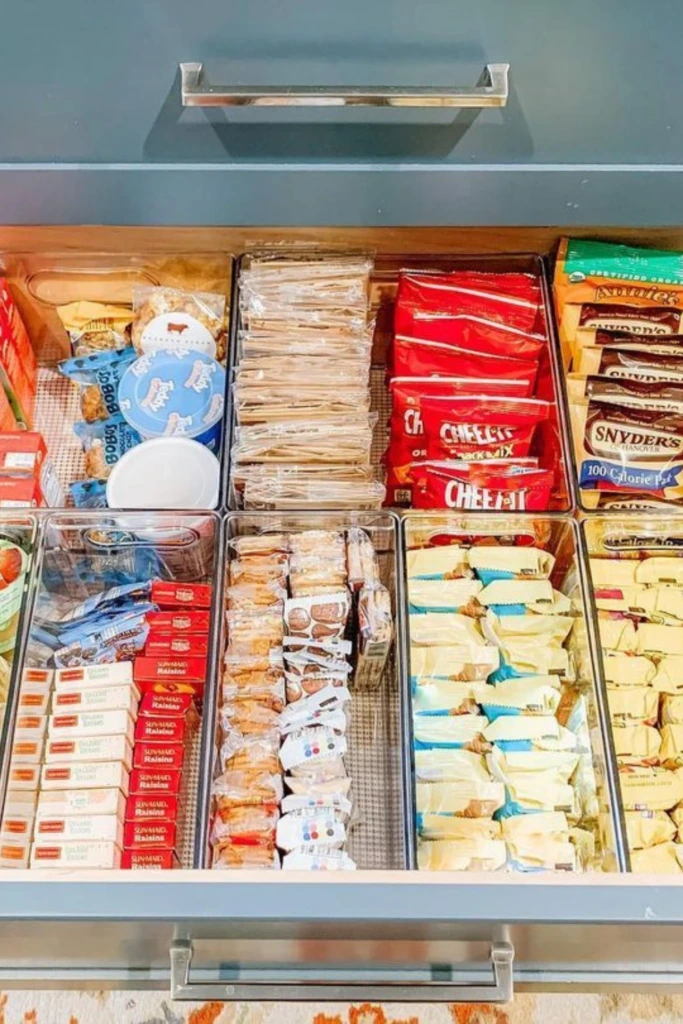
Preparing individual snack portions in advance can simplify busy mornings and reduce the time spent searching through large packages.
Use small reusable containers or appropriately sized food-safe bags to divide shelf-stable snacks into convenient servings.
Arrange the prepared portions in separate bins for school lunches, work breaks, or afternoon snacks.
You can also create a designated section for each family member, especially when dietary preferences differ.
Prepare only quantities that can be stored safely, and keep refrigerated foods chilled until needed. A little preparation can make the entire week's snack routine more manageable.
8. Snack Organization Shelf
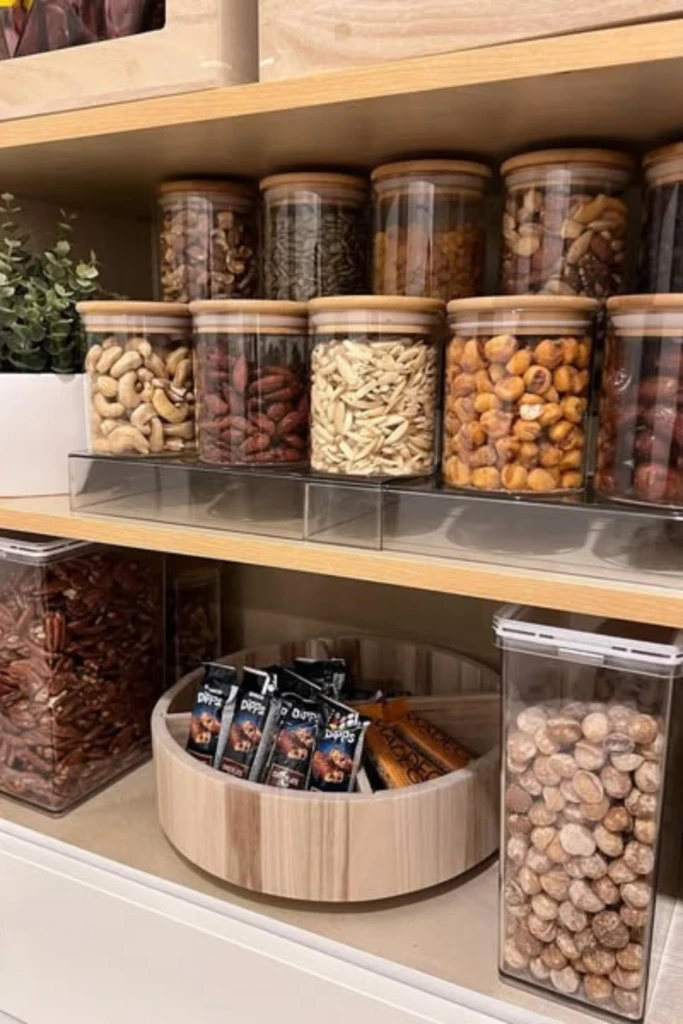
Transforming one pantry shelf into a dedicated snack area creates a central location for everything your household enjoys.
Arrange larger containers toward the back and smaller packages near the front. Use shallow baskets or pull-out trays to keep individual packets together.
Consider adding a shelf riser if you have enough vertical clearance. This allows smaller containers to sit above other items without becoming hidden.
Choose a location that is easy to reach and away from excessive heat or direct sunlight.
A dedicated shelf also establishes a clear storage limit, helping prevent unnecessary purchases and overcrowding.
9. Counter Canisters
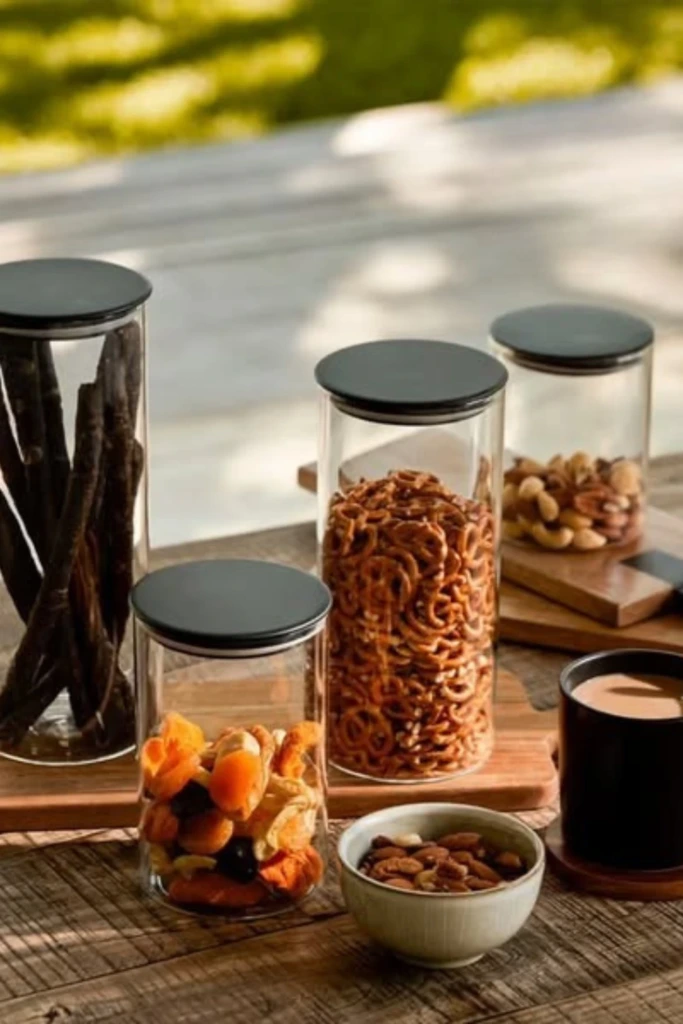
Attractive canisters can turn frequently eaten snacks into part of your kitchen's everyday organization.
Choose glass, ceramic, or food-safe plastic containers with secure lids. Fill them with suitable dry snacks such as pretzels, cookies, crackers, or trail mix.
Group two or three canisters on a tray to create a coordinated arrangement without cluttering the entire counter.
Keep them away from the stove, sink, and direct sunlight to protect their contents.
If children regularly use the snack area, lightweight, shatter-resistant containers may be more practical than glass.
10. Snack Cart
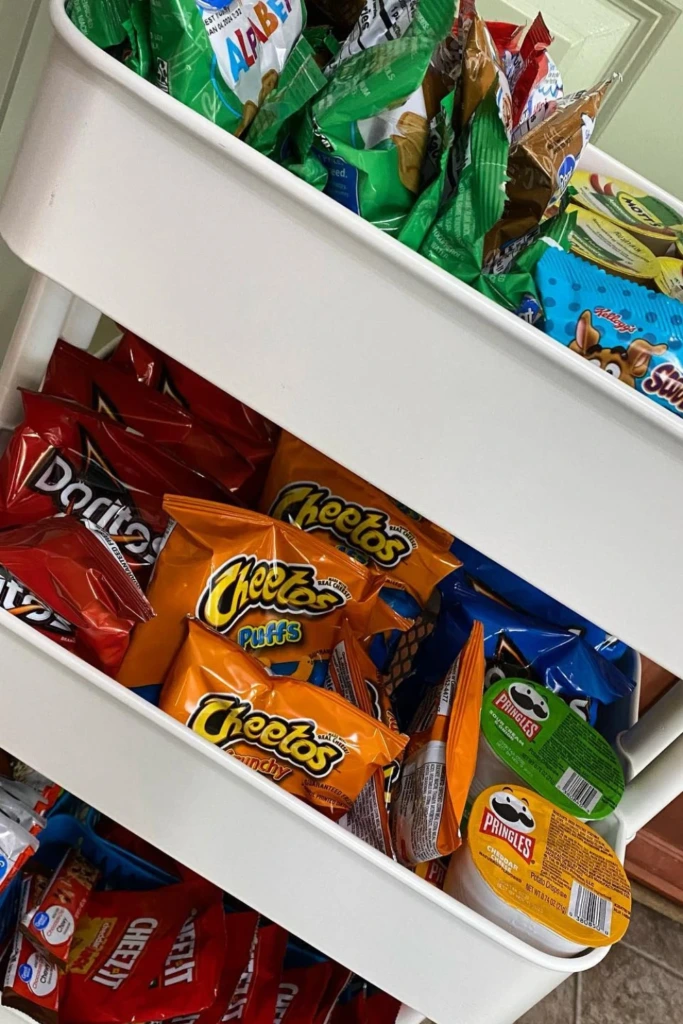
A rolling cart provides flexible snack storage when pantry shelves and kitchen cabinets are already crowded.
Choose a narrow cart with two or three tiers that can fit beside a cabinet or in an unused corner.
Place lightweight snacks on the upper shelves and heavier supplies near the bottom for stability. Small baskets can separate packaged treats, snack bars, and lunchbox items.
Look for a cart with locking wheels if it will remain in one location most of the time.
This solution works particularly well in apartments, shared kitchens, and homes where additional permanent storage isn't practical.
11. Snack Rows
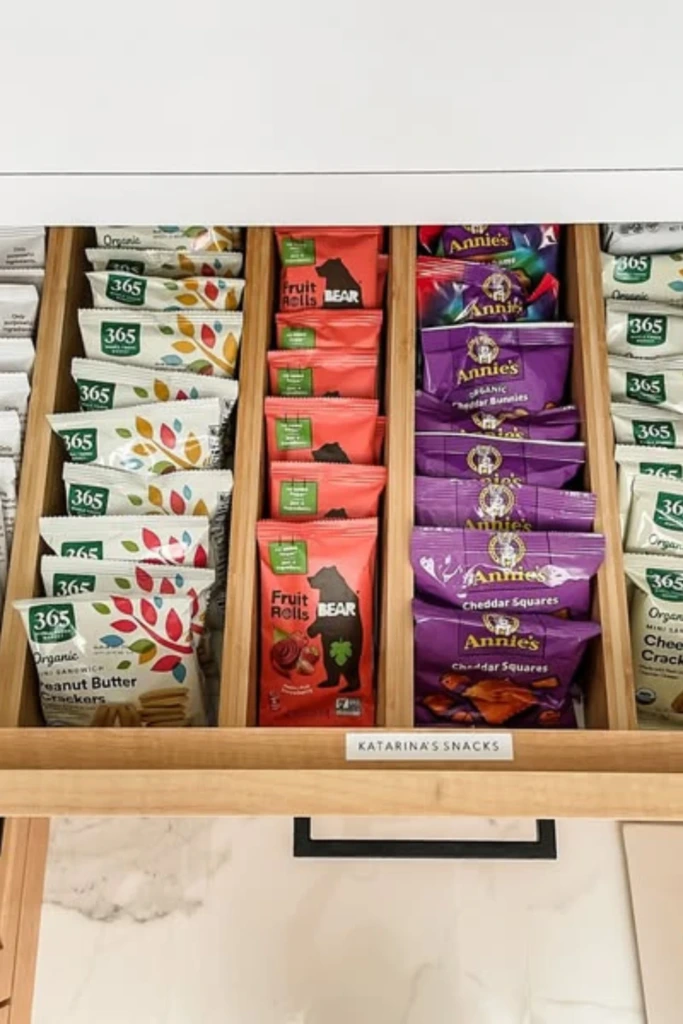
Creating straight rows of snack packages makes drawers look organized while helping everyone see what is available.
Start by grouping similar items according to size or category. Place taller packages together and arrange smaller snacks in neighboring sections.
Drawer dividers can maintain the rows even as snacks are removed throughout the week.
For extra convenience, position the most frequently selected items toward the front.
Rather than arranging everything purely by color, prioritize a layout that helps family members find snacks quickly and return unused packages to the correct place.
12. Snack Pantry Zones
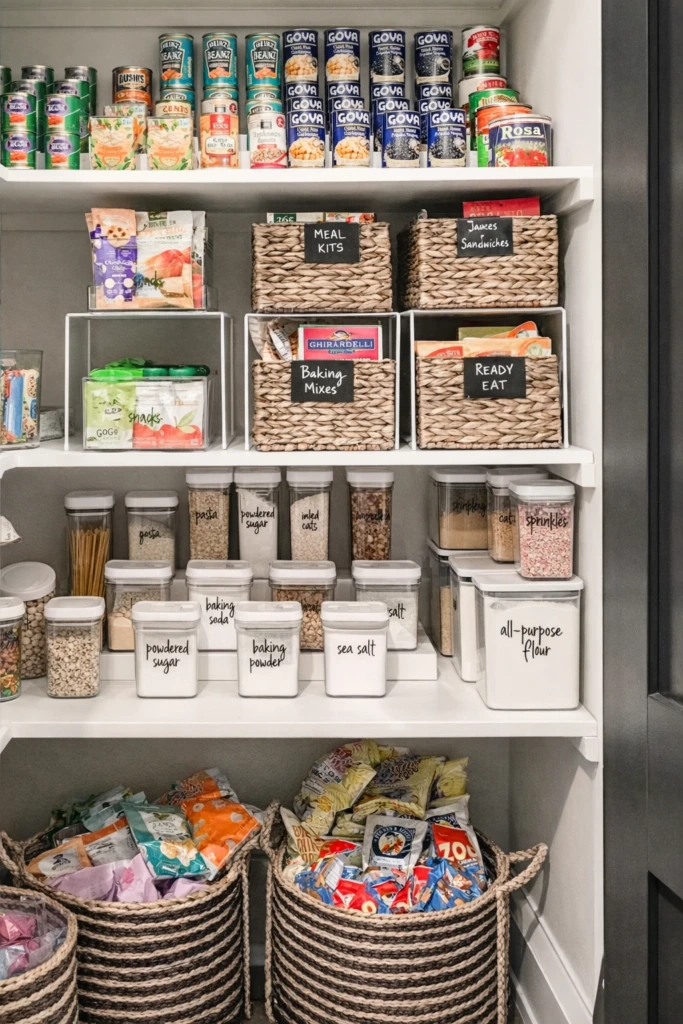
Dividing your pantry into clearly defined snack zones prevents different products from becoming mixed together.
You could designate one section for lunchbox foods, another for savory snacks, and a third for occasional sweet treats.
Use baskets or bins to establish boundaries between categories. Add labels that describe what belongs in each area.
Keep everyday foods at accessible heights and store heavier packages on lower shelves.
This system is especially useful for larger households because it allows several people to use the pantry without disrupting the overall arrangement.
13. Snack Shelf Stacking
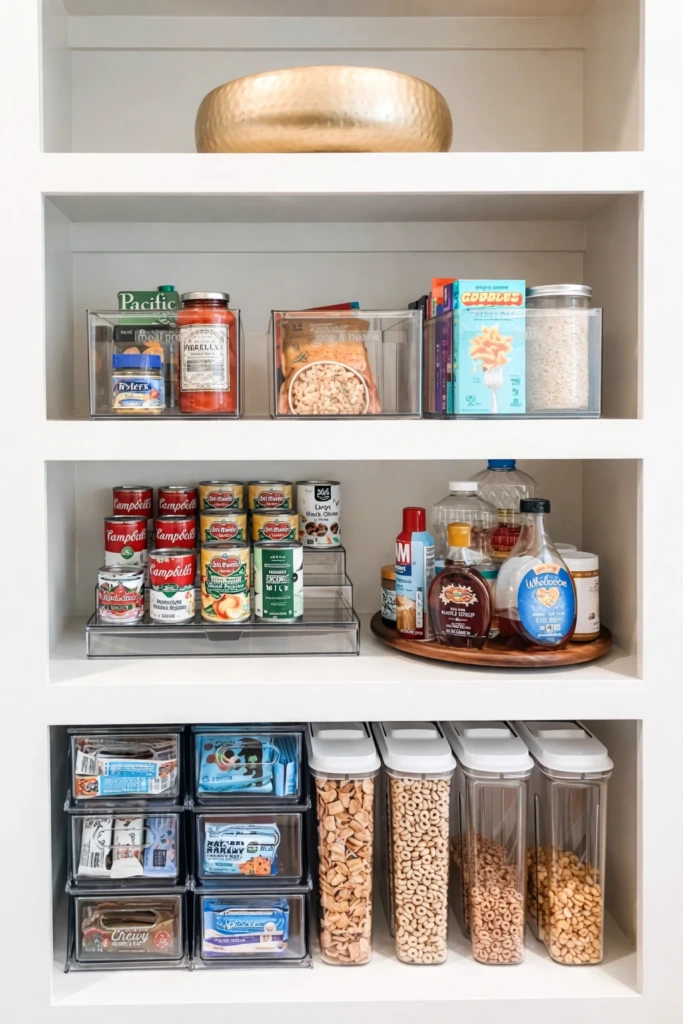
Making better use of vertical shelf space can significantly increase storage capacity without requiring additional cabinets.
Add sturdy shelf risers to create two levels for smaller containers and packaged snacks. Place shorter items underneath and taller packages where there is sufficient clearance.
Stackable bins are another option, particularly for lightweight, individually wrapped products.
Make sure the organizers are stable and that lower containers remain accessible without removing several items first.
Avoid stacking heavy glass jars or unstable packages above shoulder height. Safe, convenient access should always come before maximizing storage.
14. Snack Organization Cubes
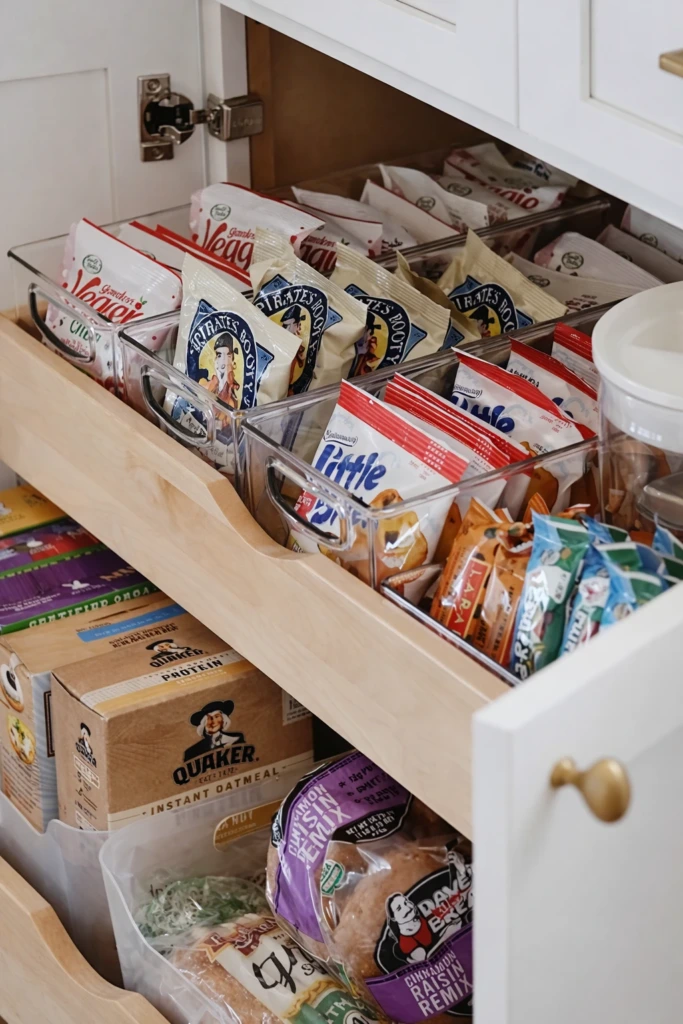
Small storage cubes are ideal for organizing individual snack packages that tend to get lost in larger containers.
Use a divided drawer organizer or a collection of small square bins to create separate compartments.
Assign each compartment to a particular item, such as mini crackers, fruit snacks, small cookies, or cereal bars.
This setup works best when the snacks are relatively similar in size.
You can also use the compartments to establish practical quantity limits. When one section is full, extra packages can remain in a separate backup storage area.
15. Snack Packet Lines
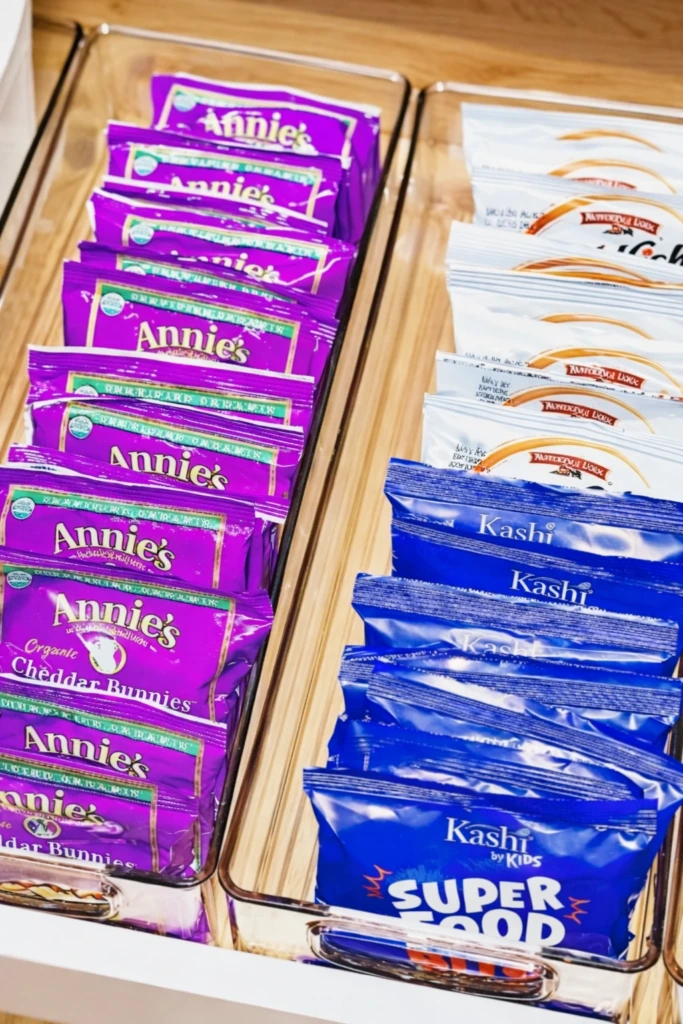
Thin snack packets often become difficult to find when they are stacked horizontally inside deep drawers.
Instead, arrange them vertically in long, narrow organizers, similar to files in a filing cabinet.
This method works well for fruit snacks, instant oatmeal packets, small biscuit packs, and other flat packages.
Keep the labels facing forward whenever possible, and avoid squeezing too many packets into a single compartment.
As you restock, move older products toward the front and place newer purchases behind them.
The result is a compact arrangement that makes individual packets easy to remove without disturbing everything else.
16. Snack Display
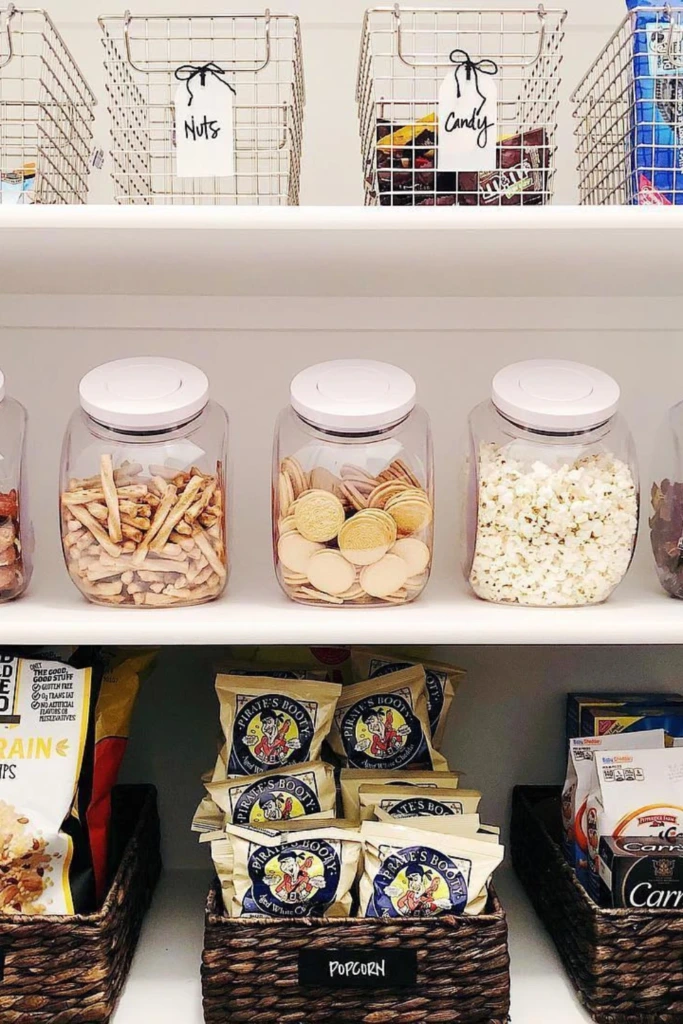
An open snack display combines everyday convenience with an inviting kitchen arrangement.
Use a small shelving unit, countertop stand, or accessible pantry section to showcase frequently eaten snacks.
Place packaged foods in decorative baskets and store appropriate loose snacks in covered containers.
Mixing containers of different heights can create visual interest, but keep the arrangement simple enough to maintain.
If your display is in a shared family space, consider including a variety of options that suit different preferences.
Avoid placing perishable snacks on open shelves unless their storage instructions allow it.
17. Snack Drawer Lanes
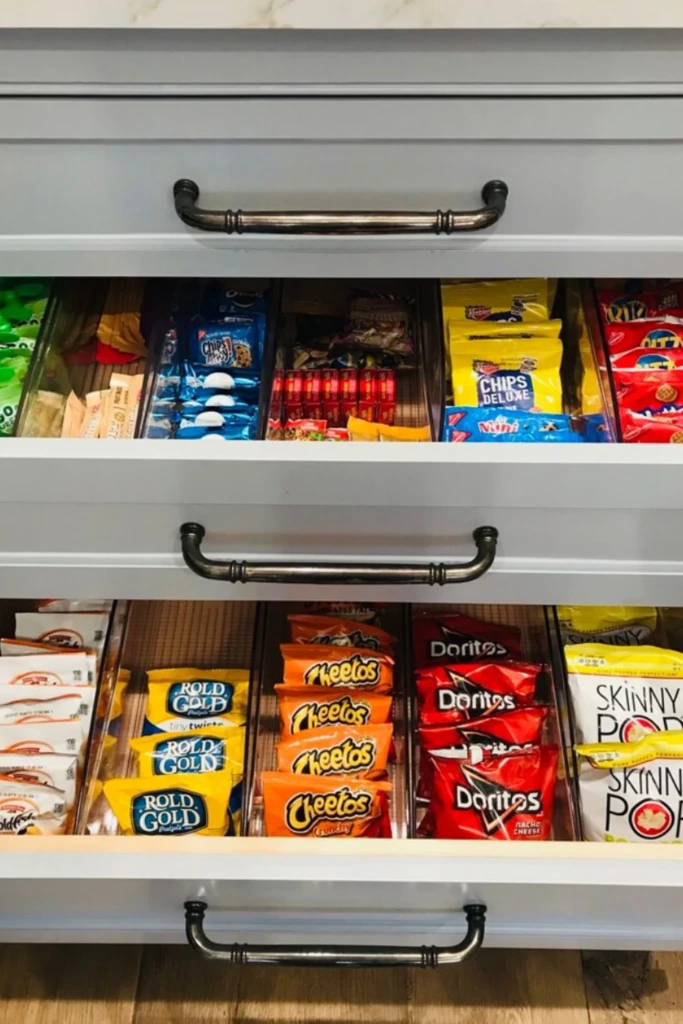
Long drawer lanes are particularly effective for keeping packaged snacks from shifting whenever a drawer opens or closes.
Install adjustable dividers running from the front to the back of the drawer. Use each lane for a different snack category.
For example, one lane might hold cereal bars, another small chip bags, and another individually wrapped crackers.
Choose dividers that fit securely and are tall enough to keep packages separated.
This design is useful in medium-depth drawers where loose packages would otherwise overlap and make the contents difficult to see.
18. Snack Sorting Pods
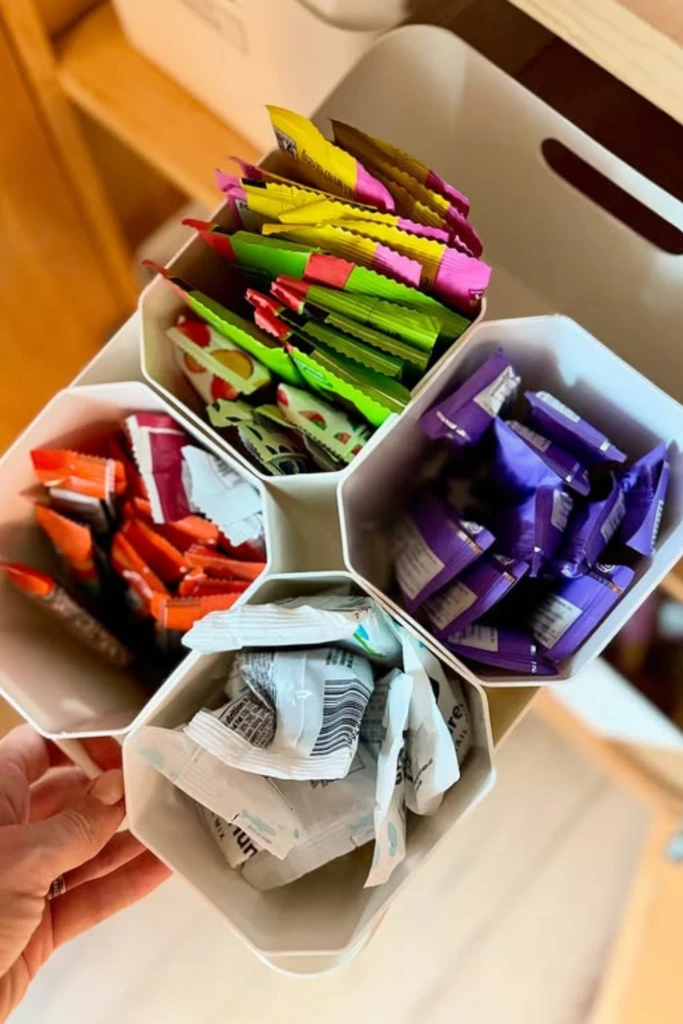
Individual sorting pods offer a practical solution for organizing small snacks without needing several large storage containers.
Use a divided tray or a set of compact, removable bins inside a cabinet or drawer.
Each section can hold a particular type of packaged snack, allowing you to separate different varieties without creating unnecessary clutter.
Removable organizers are especially convenient because they can be lifted out for cleaning or refilling.
Choose smooth, washable materials, particularly if you plan to store unwrapped food in food-safe compartments.
This approach is ideal for households that enjoy keeping a variety of small snacks available.
19. Labeled Snack Bins
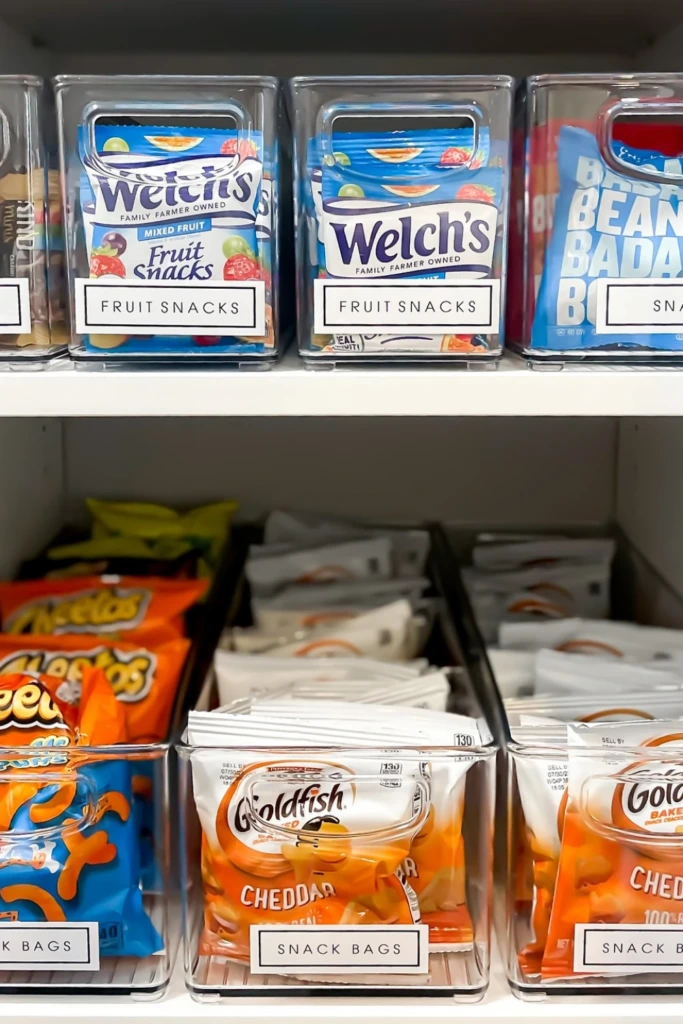
Labeled bins are among the simplest and most adaptable ways to organize a busy snack collection.
Choose containers that fit your shelves, then assign each one a broad category such as chips, crackers, bars, or lunchbox snacks.
Attach labels to the front so they remain visible even when the bins are pushed toward the back of a shelf.
Clear containers allow you to see their contents, while opaque baskets can create a more uniform appearance.
For younger children, picture labels can make the system easier to understand.
Keep the categories broad enough that you won't need to replace labels every time your grocery selections change.
20. Snack Category Shelves
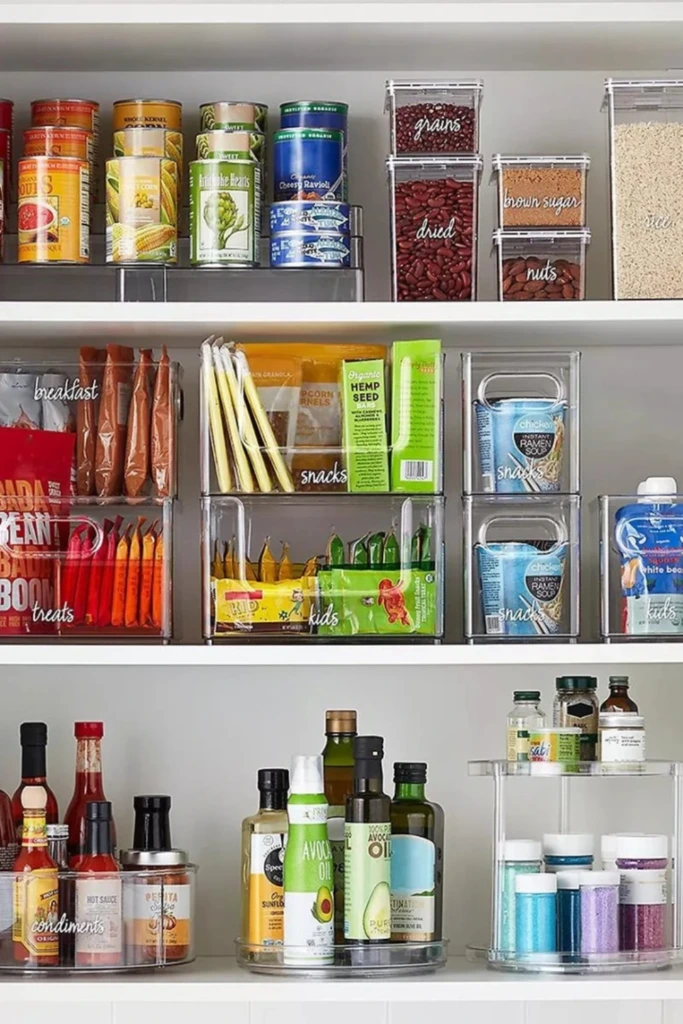
If you have a large pantry, dedicating separate shelves to different snack categories can make food storage much easier.
Place everyday grab-and-go items on the most accessible shelf. Reserve another level for larger packages or less frequently eaten treats.
If multiple family members use the pantry, organize some sections around their routines, such as school lunches or work snacks.
Use small bins within each shelf to prevent packages from spreading into neighboring categories.
Keep heavier items low and avoid placing frequently used products where they require a step stool.
A consistent shelf arrangement helps everyone know where to look and where to return items.
21. Snack Container Grid
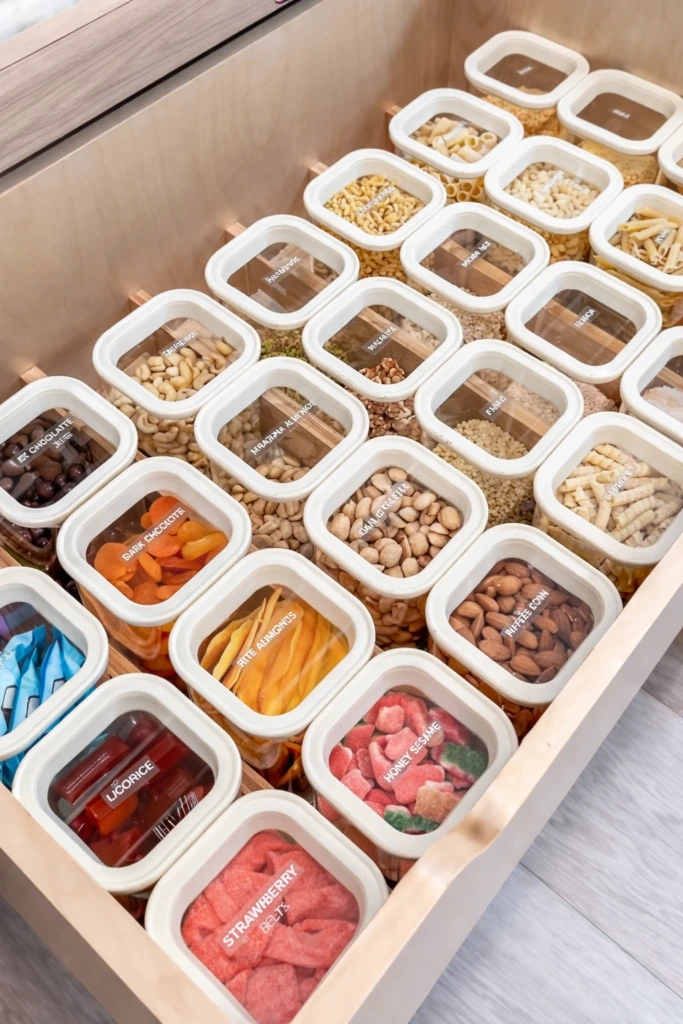
Matching containers can turn an irregular collection of snack packages into a space-efficient drawer layout.
Measure the interior of your drawer and select food-safe containers with dimensions that allow them to fit together neatly.
Rectangular containers often work particularly well because they leave fewer awkward gaps.
Use individual containers for crackers, pretzels, dried fruit, or other compatible foods. Choose airtight options when needed to preserve quality.
Leave a little room inside each container so lids close securely and snacks aren't crushed.
This arrangement also makes cleaning easier because individual containers can be removed without dismantling the entire drawer.
22. Snack Jar Lineup
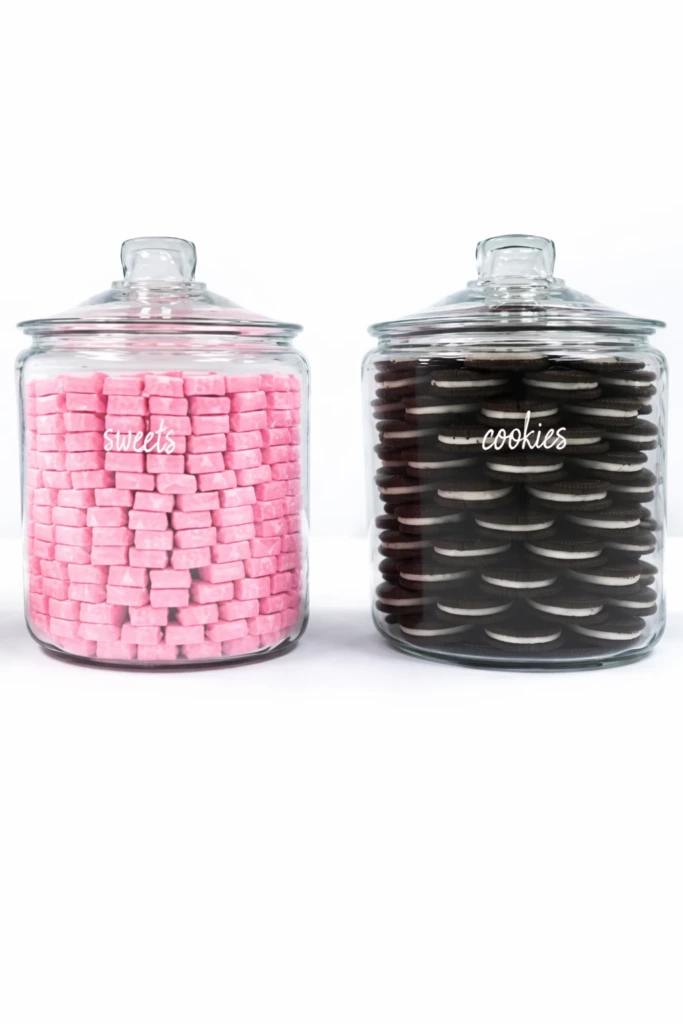
A row of coordinated jars offers a simple way to store dry snacks while giving pantry shelves a polished appearance.
Choose jars with wide openings so they are easy to fill, clean, and reach into.
Suitable options include nuts, pretzels, cereal, cookies, and other shelf-stable foods that won't be damaged during storage.
Add labels identifying the contents and include date information when useful.
For foods containing common allergens, clear identification is particularly important.
Place larger jars toward the back if using deep shelves, and keep heavier glass containers at a comfortable lifting height.
Matching jars can look attractive, but practical lids and easy cleaning matter more than appearance.
23. Snack Cabinet System
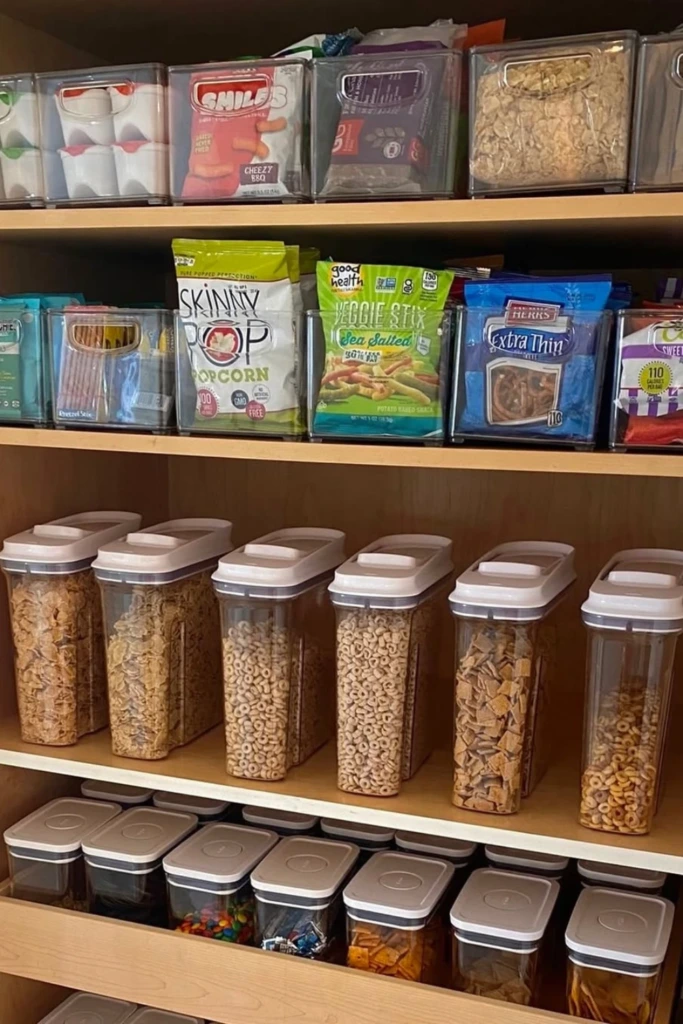
A dedicated snack cabinet is a smart alternative when your kitchen doesn't have a traditional pantry.
Begin by removing unrelated items and deciding how much cabinet space you can comfortably allocate to snacks.
Use pull-out bins for packaged products and sealed containers for suitable dry foods.
Arrange frequently used items at eye level, with occasional snacks or backup supplies in less prominent positions.
If the cabinet is deep, sliding organizers can prevent products from being forgotten at the back.
Keep snacks away from household cleaning products and choose a cabinet that remains cool and dry.
This creates a convenient storage area without requiring additional furniture.
24. Snack Basket Zones
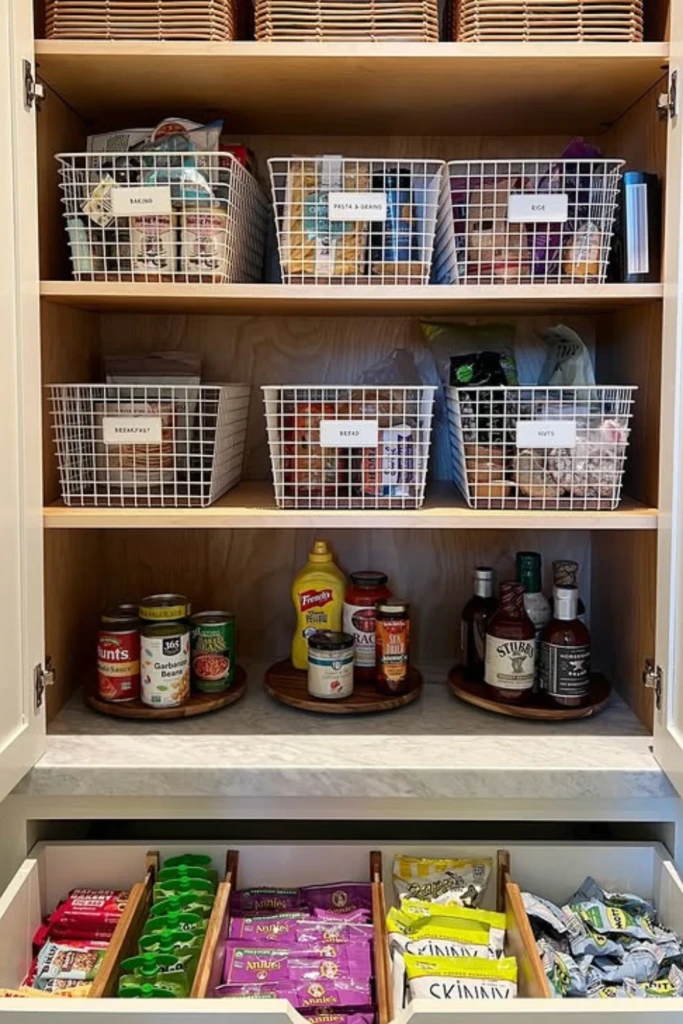
Baskets are useful for containing bulky packages that don't fit neatly into jars or small organizers.
Wire, plastic, or woven baskets can all work, depending on the location and the types of snacks being stored.
Choose washable or wipe-clean options for areas where crumbs and spills are likely.
Assign each basket a specific purpose, such as popcorn, chips, crackers, or extra snack supplies.
Baskets with handles are especially convenient on deeper shelves because you can pull the entire collection forward.
Avoid filling them so tightly that packages become crushed or difficult to remove.
A few well-chosen baskets can make an ordinary cabinet much easier to manage.
25. Snack Pouch Stand
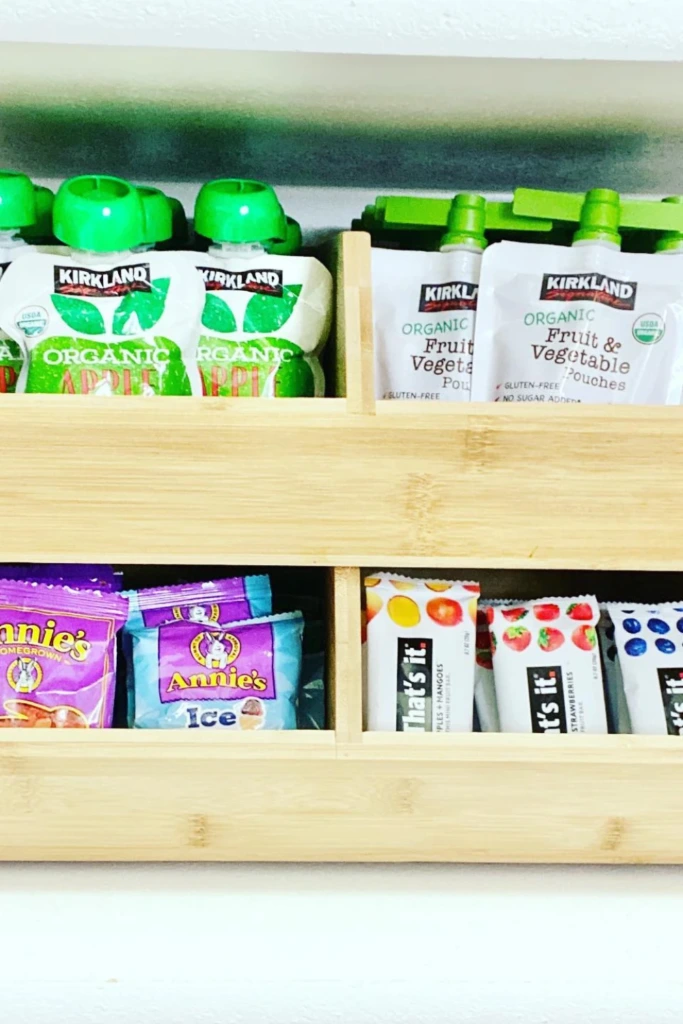
Soft snack pouches can be frustrating to store because they frequently slide over or become buried beneath other products.
A tiered organizer or upright storage rack helps keep them visible and accessible.
Arrange pouches with their labels facing outward, and separate different varieties into individual sections.
Check that the stand is deep enough to support the packages without bending or puncturing them.
For families with young children, store age-appropriate pouches at a convenient height while keeping products that require supervision out of reach.
This storage method is particularly useful for shelf-stable fruit purées and similar packaged snacks.
26. Snack Drawer Blocks
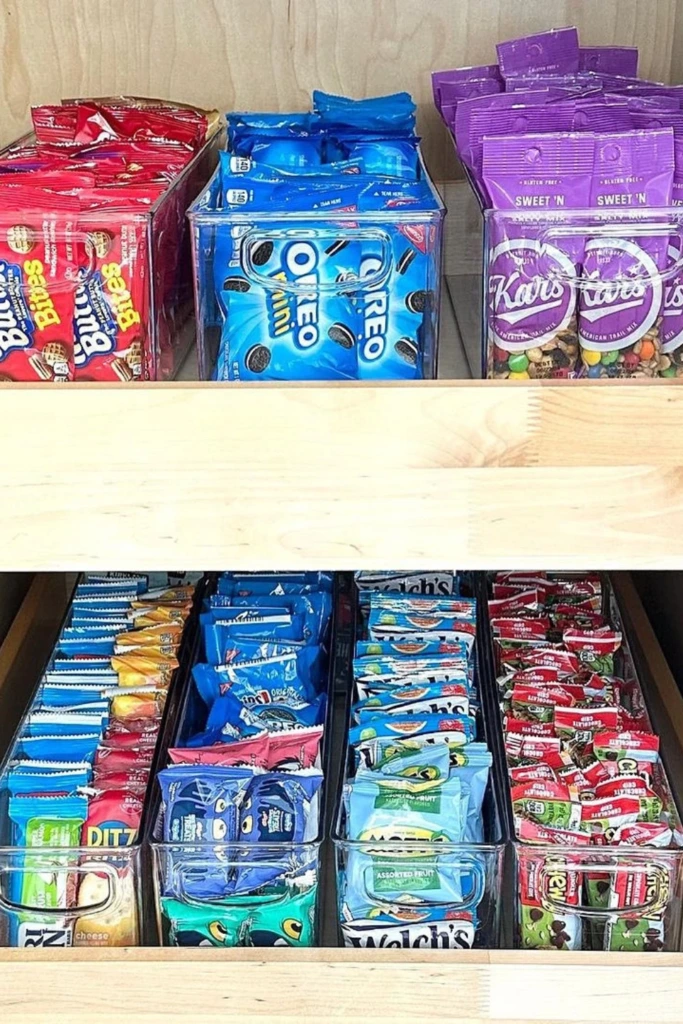
Organizing a drawer into distinct rectangular blocks creates a flexible layout that can accommodate several types of snacks.
Choose a combination of medium and small bins that fit together inside the drawer.
Dedicate larger sections to bulky packages and smaller sections to compact items such as cereal bars or individually wrapped treats.
Leave enough clearance for the drawer to open and close smoothly.
Unlike permanent dividers, removable bins can be rearranged whenever your snack preferences change.
This makes the system practical for households that purchase different products throughout the year.
How do you keep snacks organized long-term?
The easiest way to maintain an organized snack area is to create a system that requires very little effort to use.
Keep categories straightforward, make sure every item has a designated location, and avoid buying more than your storage space can comfortably hold.
Before grocery shopping, check existing supplies to prevent duplicate purchases. When restocking, place newer products behind older ones and review expiration dates.
A quick weekly check can help you remove empty packaging, wipe away crumbs, and return misplaced snacks to their proper sections.
Most importantly, choose containers and storage locations that match your family's everyday habits. A practical arrangement is much easier to maintain than one designed only for appearance.
What’s the best way to organize snacks in a small kitchen?
In a small kitchen, focus on using existing storage more efficiently rather than adding unnecessary furniture.
Deep drawers, narrow pantry bins, shelf risers, and compact stackable organizers can help maximize available space.
Remove bulky outer packaging when appropriate, but retain important food information such as expiration dates, ingredients, and storage instructions.
If cabinet space is limited, consider a slim rolling cart or a small dedicated shelf for frequently used snacks.
Keep your most popular items accessible and store extra supplies separately when space allows.
The best solution is one that keeps snacks contained, easy to locate, and out of the way of essential cooking and food preparation areas.